I ate a cookie with my coffee this morning. As I ate the cookie it came to me once again that I would like to read “War and Peace.” I read “Anna Karenina” Anna is a tragic character because she never realized she was enough. But it wasn’t her fault because she was the victim of a rigid society. She was ostracized for having an affair that resulted in unrequited love. To add insult to injury her son was taken away from her and she wasn’t allowed to see him. The last time she saw him was out of secrecy. Desperate and lonely, she killed herself.
A Tragedy
I will finish reading “East of Eden.” Steinbeck is one of my favorite American authors. He’s the best.
I also would like to read “Roots” by Alex Haley and “Bury My Heart at Wounded Knee.”
A shell collection I picked up on the beach over time. A few I bought at a store. I like the broken and scuffed up imperfections of those found at the shore. Shells are wonderful concrete objects from nature with a variety of shapes and forms. Once they are in my pocket, rescued from the beating waves that tumble them on the sand, they can finally find a home where they exist intact, and impermeable to change. They will last longer than me. I keep them inside a giant glass fish bowl.
I am reading “Tom Lake” by Ann Patchett. Before TL I read “Our Town” a play by Thornton Wilder because Patchett’s book is in part based on Wilder’s work.
The landing on the moon, July 20th 1969, and the ability of the media to broadcast it over national television, is an historical event that is etched prominently in my memory. Neil Armstrong, Buzz Aldrin and Michael Collins made the voyage to the moon in the vessel called Apollo 11.
But why the moon? It was a challenge by JFK to put a man there, before the decade ended. Other reasons too, I suppose. For the advancement of science, and to send the message to Russia that the US was bigger and better than them.
Other events took place in 1969, such as the Woodstock concert, and the advent of Sesame Street, not to mention the invention of the internet, at least according to Google.
The landing on the moon “A Giant Leap” ended a turbulent decade in the US, whereby Race Riots and the War in Vietnam engulfed the psyche of the country, and mounting tensions across the land, and still do today. For some people, anyway.
By the end of the 60’s I was moving into my teenage years, and still, current events influenced to a degree, my fragile development. I came from a social, and politically minded family. I had a brother in Vietnam. My father, a liberal minded man who fought as a foot soldier in WWII, and my mother, an art teacher, all influenced my upbringing. And I had six siblings to bounce ideas and feelings off of, on a daily basis.
So, I witnessed the events of the 60’s with the newspaper in my hand, and listened to my parents in their adult fashion express their dismay, skepticism, and hopes for the future. Yet, despite my privileged upbringing emphasizing the importance of having an open mind, I ponder, where has that “Giant Leap for Mankind” brought us fifty-four years later, in 2023? Has it all been for humankind? How much was salvaged, how much was thrown away?
Yet, most of all, I look back at the landing on the moon with curiosity and wonder, because the moon has so many poetical possibilities; a source of human emotions since time began, and a symbol of positive power and creativity. In my mind, the moon will always represent Hope and Love. When they launched a rocket and put a man on there, I question, how many saw it the same way?
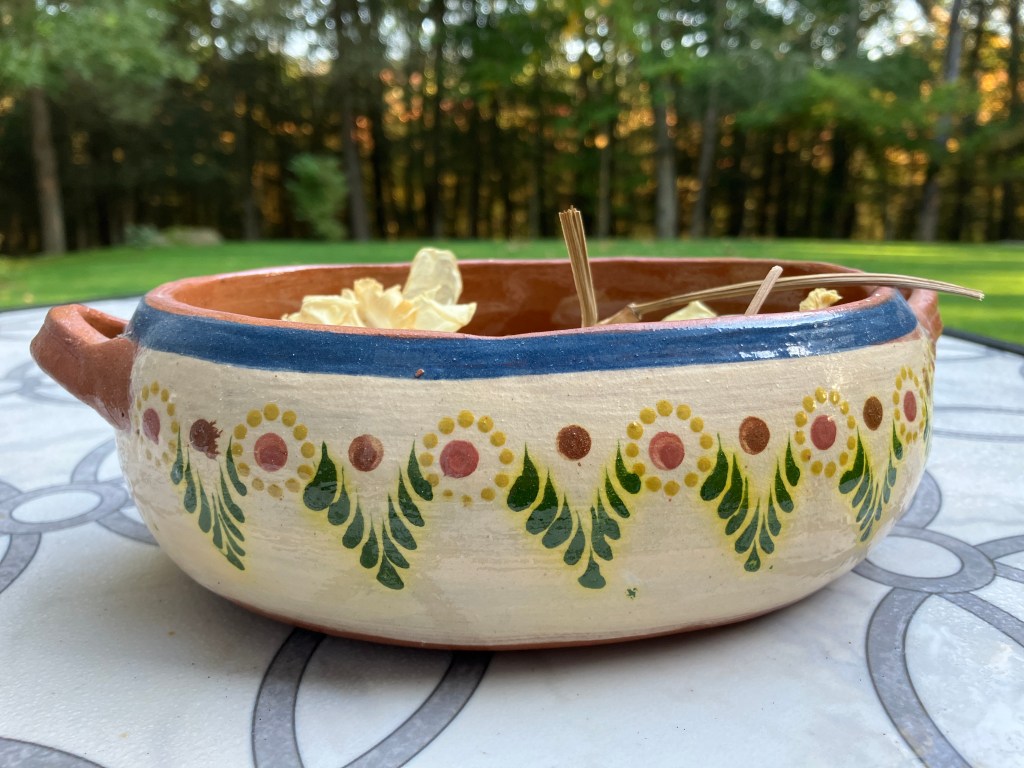
I would like to learn how to do ceramics. Either, to throw a piece, or hand build some objects of art. I would like to learn about different ceramic glazes and techniques. Ultimately, I would like to be able to use shape, form, and color to express emotion and to reflect my environment through clay. I know, that in order to make ceramics you must work hard to acquire the skills that go into the process. Maybe some day I will find the time to accomplish my goal.
The soul grows bigger as it holds more thoughts, instead of shrinking them all down to the size of a single solution. And as we become more abundant in our souls, we can bring increased wisdom and acceptance to many areas of life.
Another benefit is the possibility of finding more profound and lasting solutions to our life problems. If we rush to solve a problem, the solution will need to be ready made or quickly put together, and will most likely be a project of the ego; but if we sustain the tension created by two worlds colliding, an unexpected solution will emerge eventually from the opening to soul that tension creates. If we tolerate moments of chaos and confusion, something truly new can come to light.
“Darkness Fall on the Land of Light, Experiencing Religious Awakenings in Eighteenth-Century New England” By Douglas L. Winiarski
I am reading this book. At first I thought it would be a daunting read but it has turned out to gather my interest quite easily. Winiarski researched letters, diaries and journals from the mid 18th century in New England to understand the religious awakening which began in about 1741. This awakening was lead by a minister called George Whitefield. Whitefield rejected the conventional norms of Congregationalists, and began giving emotionally driven sermons around New England. Other riding ministers emerged, and thousands of converts ascribed to the idea that it wasn’t enough to go to church weekly, and read the bible to be saved. One had to personally and individually surrender their body and soul to God. The movement encouraged the documentation of these experiences and consequently a wealth of material survived. Winiarski describes the emergence of ‘a pluralistic religious culture’ that shook the communities in the 1700’s. This First Awakening was a precursor to the Second Awakening which gripped the population in the early 1800’s, and which traveled with people that migrated to new frontiers. In reading this book, I can better understand the presence of the religious fervor Americans have in the 21st century, and the tendency to be swept up by a culture in a desperation to understand their existence. These are beliefs that serve to validate a person’s sense of morality as familiar wisdom within a community, and which are totally unfounded in scientific inquiry. We see it exaggerated on the nation’s political scene. In fact, the power and dynamism of the fairy tales that George Whitefield adopted to captivate people reminded me so much of the rallies performed by Donald Trump. I am on Part Three called “Exercised Bodies, Impulsive Bibles.”
My simple explanation here doesn’t do justice to the complexity of Winiarski’s book but at least shows my interest in the topics of this deeply researched book, published by the Omohundro Institute of Early American History and Culture, Williamsburg, Virginia, by the University of North Carolina Press Chapel Hill, 2017.