What Came to Be

Deciding whether or not to buy that pumpkin could be a lost opportunity, but for what? Three days ago my daughter mentioned she would like a pumpkin, and if I would please check the local market for one on my way home from an errand. So I passed by the market and checked out the supply. One in particular looked pretty good. After checking out its shape, size and condition, I pondered – would this pumpkin be OK? I actually considered not taking it into the store to purchase – I’m not sure what held me back. Its slight imperfections – would it fit the bill? Too much over analyzing – for sure. Well, I took the plunge and lugged it inside to the cash register, where the person bagging groceries said, Do you have candy for the trick or treaters? I said, “No!” “I better get some.” He agreed and was happy to influence me. I didn’t tell him we hadn’t had a trick or treater for 20 years. So, after buying my candy and pumpkin @ $9.99. I asked the man, not young, not old, but a familiar face, bagging groceries, if he wouldn’t take my pumpkin to the car for me. It was kind of heavy. He was happy to oblige. On our way I asked him if he remembered the huge blizzard we had in 2011, which totally ruined our Halloween; the years when we used to get tons of children at the door. He said, “Yes, of course, I remember it.” And proceeded to tell me that night of the storm he was drinking and driving, hit black ice and had a horrible car accident. He said he hasn’t had a drink since. I was impressed with his story and told him I knew a few men who have chosen the same path as he has.

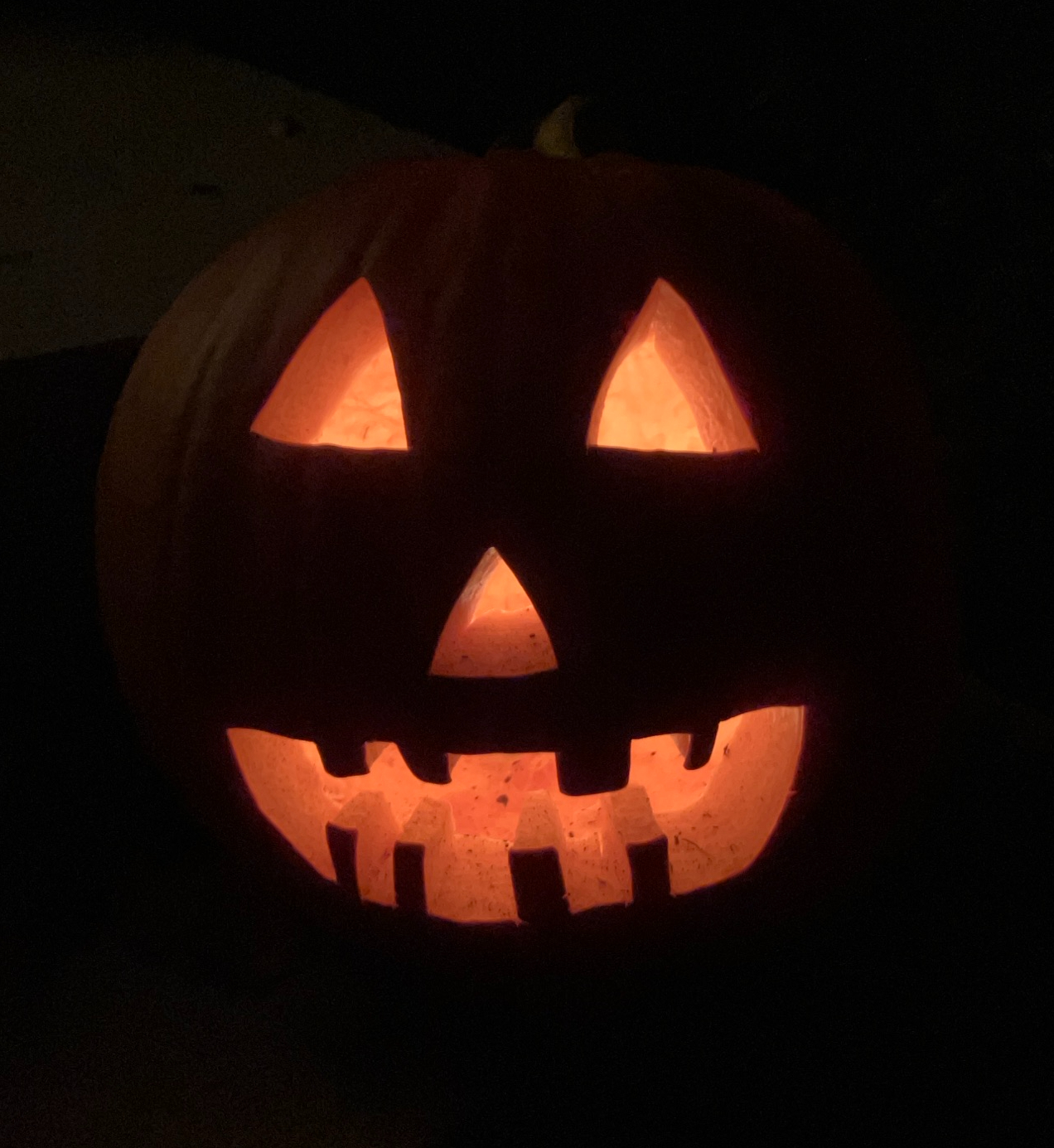
So, if I hadn’t gone in to the buy the pumpkin, I never would have heard the not so old man’s story, a person who has waited on me invariably since the times of Covid, and who has never ever opened up to me in all that time. I took the pumpkin home to my daughter, who excitedly carved out this jack-o-lantern, for her own 14 month daughter, whom she dressed up like a little witch, and marched her up and down the street to stop at all the houses with their lights on to go trick or treating. I think she was the only one out, but still neighbors were hopeful that someone would stop. The pumpkin sat outside on our doorstep with a candle-inside, to chase away all the evil spirits flying through the air.

All of this came to be…
Cultivo una rosa

Cultivo una rosa blanca

en julio como en enero

para el amigo sincero

que me da la mano franca

y para el cruel

que me arranque el corazón

Cardo ni ortiga cultivo

Cultivo una Rosa Blanca.

Por José MartÍ

I cultivate a rose

in July as in January (Warm or cold, it matters not.)

For my sincere friend

who gives me his honest hand

and for the cruel one

Who pulls out my heart

Neither thistle nor thorn

do I cultivate.

I cultivate a white rose.

“Cultivo una rosa blanca” was written by José Martí, a patriot, poet and journalist, who fought to help liberate Cuba from Spanish rule and colonialism.

The poem, which I memorized eons ago came to me in the night as I tossed and turned to go back to sleep. Funny to have such a memory, but there is a reason for everything. Life can be a struggle and we move through it like water in a deep lake. Sometimes our movements in what ever form they should take are made without thought for the repercussions, or waves they make. Unbeknownst to ourselves, our actions and words may hinder the tender heart of someone whose silent pain we are unfamiliar with, but nonetheless our interactions are significant. We may be the honest friend at times who lends a hand or we may be the cruel friend who pulls out someone’s heart. The point of the poem is to be able to turn the other cheek and forgive, when we are the recipient of some else’s words or actions. The harder part is to realize when we are the one who causes the hurt, or anticipate it before it happens.

Pema Chodrön would say, we all need to lighten up and let it go, and act with kindness and compassion. And then there is the quote by Oscar Wilde, “morality is knowing where to draw the line.” This is a good measure to embrace, lest we should pull out the heart of someone we love, who may, or may not forgive us.

Love

A Book I Loved

The Novel, “Remarkably Bright Creatures,” kept me on the edge of my chair. Stirring me to tears through the last 3 chapters, RBC is about loneliness and loss. Shelby Van Pelt’s main character Tova, is an elderly woman of Swedish ancestry who in her janitorial duties at an aquarium in Washington state, loves and cares for Marcellus, an aging octopus. It turns out the octopus through his soliloquies and cunning behaviors, helps Tova and the reader see the truth; that her son Erik thirty some years before, who lost his life in a boating accident, couldn’t have killed himself like everyone in the town were rumored to believe. A young man named Cameron, from Southern California, comes to the town where Tova lives in search of the father he never knew, only to find that the truth is not as simple as he thought. This novel brings together a mix of unforgettable characters of every day walks of life I grew to love. They feel like real people from the lower echelons of society, struggling to make ends meet, each defining their unique purpose in life. Tova is the strong individual who teaches us that doing things the proper way matters in life and that relationships with humans and even an octopus are the reason for our being on this planet. This is a story of how human beings are supposed to be; how actions speak louder than words.

Little Stream

Little stream,

You bursted at your seams

from all the rain that fell.

I crossed your stepping stones,

and sat on a moss covered rock

on the other side.

I reached down and touched

your crystal clear, cold water.

Then, I watched you flow down

the gentle hill, until your winding

glistening rivulets ran out of sight.

Little stream.

By TiffanyCreek

I have to write about this now…

I finished a book on my Kindle this morning called “Blue Nights.” I should say the book ended, but I didn’t expect it to end. I didn’t want it to end. Like one of those movies the curtain closes on, and you are left with more questions than answers. In Joan Didion’s “Blue Nights” haunting and dismally depressing, the art of her writing expressively tells us about her grief over the death of her 39 year old adopted daughter Quintana Roo, and about so many other parts of her life. We feel her grief and we feel everything she has to say. Her misgivings about her own parenting. Her feelings of guilt for perhaps contributing to her daughter’s death. Her inability to foresee that Quintana headed down a road to alcoholism, because of her mother’s unbridled drive to write and write and write, despite all the red flags. Did Joan’s obsession with work push her daughter into self-annihilation? Had Joan made herself more available, would her daughter have grown into a healthy woman, maybe even a mother herself? Many critics have allured to the same. Even Joan comments on how all Quintana knew as a child was the life of fancy hotel rooms and movie sets. Yet, Mother shaming is nothing new.

Joan wrote “Blue Nights” in 2011, several years after Quintana died on August 26th of 2005. In October of the same year she published “The Year of Magical Thinking,” another memoir about mourning over the death of her husband John Gregory Dunne, who slumped over lifeless in his evening chair from a heart attack, in 2003. Obviously the time couldn’t have been worse. While she was writing in grief over her husband’s death and about ready to publish her work, their own daughter expired from a bout of pneumonia caused by the flu. (NPR) In “Blue Nights” she wrote in detail of the death itself, the visit to the hospital with her son-in-law and the subsequent memorial.

With raw realism of “Blue Nights” Joan revealed her own surmounting health issues from aging, and her fear of being alone. She starkly expressed how one night after she went out she came home and in the morning found herself passed out in a pool of blood in her apartment. She realized that more than ever she needed someone by her side in her old age, and she wished more than anything that she had Quintana Roo.

There is nothing new about Joan Didion’s aloneness as a widow, and a parent who lost a child. Plenty of older men and women find themselves in this situation with much meager means to provide care for themselves than Didion. But it is the artfulness with which Didion tells her story, and the poignancy of her feelings that spill out on the page that drew me into reading on and on. Her narrative is like riding on a roller coaster, gliding down at full speed taking quick turns at the bottom and climbing back up to the summit again. Thrilling and scary, you never want it to end, but suddenly the car stops and it’s time to get off. It’s difficult to do justice in a description of Joan Didion’s “Blue Nights.” I won’t even try anymore. I can only say it’s a book to be experienced. Joan Didion is a natural writer. The volumes she left to the American literary heritage are invaluable and will undoubtedly be relevant for many decades to come. Her works should be read and she should be judged on her own merit.