Flight

The little Robins fledged in the night. Showing all signs of readiness, I wasn’t surprised. But wait! Did I see something stir? Lo and behold, the bush shook and a tiny beak emerged from inside; it was a lone runt who had not made the flight. Then Mother Robin (MR) appeared at the edge of the nest with worms, coaxing the little one to survive.

The runt spread her wings trying to flee, but with no-one to clamor over, or to act as a stepping stone to the outside, she would have to fight. On her own! MR returned with more worms. I hesitated to take out my camera for she was skittish and flew away when I did so. Mustn’t interfere with Mother Nature’s progress.

I’ve witnessed instinctual diligence unfold for 24 days, since the first of June when one of the four beautiful blue eggs was laid. MR’s dedication is a lesson for life. Day after day, she showed up at the nest. She laid one egg each day. The labor of incubation took time but once they were hatched she never gave up. She perched herself on the nest, sitting, feeding and hovering over her young in sunshine and in pouring rain. I believe she will not abandon the nest until her final babe takes flight.

New events! Later in the day, with a glance of the eye, I detected a fluttering within the lawn. By gum by golly, it was a fledgling. I thought, “did the little bird fly?” I ran to the second floor to find she was still in the nest, so the one on the lawn had to be a sibling. Where were the other two? So hot it was I set out a small bird bath for the fledgling’s mom and dad, who were roaming around the grass. I also turned the sprinkler on, which I think they liked.

Next day…

At the close of the day, I wondered what I would find when I awoke. With the rising sun my fledgling friend was still on the lawn and the little one, still in the nest.

Father Robin watched over the fledgling nestled in the fronds of the grass, while MR continued her task of nurturing her birdie in the nest. The male Robin thus far had been quiet, appearing every so often to assist his mate, but now his job was really cut out for him; to keep a watchful eye on the fledgling prancing around in the grass. The development of the fledgling to fly can take up to a week.

The works of nature are slow and gradual. Have you ever seen a flower close at the end of the day, or open at Dawn? With patience and observance we can witness Nature’s wonders. What happened with the nest outside my window is no coincidence. It was built in April by a set of Cardinals, who also raised in it a brood, and whose fledglings flew. In early June it was repurposed by these Robins. To take over another nest is an unusual behavior for birds.

Being able to view the beginning of this nest reminds me there is no end to the process of birth and renewal. Nature is an elixir to the cruelty and madness we are experiencing in the political world. All things must come to pass. Birds will keep singing, and Robins and Cardinals will keep making nests. Good will remain.

As I finish this essay the fledgling outside my window found the strength to hoist herself on the edge of the nest. She has been sitting there for the past hour and a half. In no hurry to roam too far, she opens her beak, and takes in the world around her. The question is, how long will she stay? One thing is for sure, I think this nest has had it. Happy birding!

A Book I Loved

The Novel, “Remarkably Bright Creatures,” kept me on the edge of my chair. Stirring me to tears through the last 3 chapters, RBC is about loneliness and loss. Shelby Van Pelt’s main character Tova, is an elderly woman of Swedish ancestry who in her janitorial duties at an aquarium in Washington state, loves and cares for Marcellus, an aging octopus. It turns out the octopus through his soliloquies and cunning behaviors, helps Tova and the reader see the truth; that her son Erik thirty some years before, who lost his life in a boating accident, couldn’t have killed himself like everyone in the town were rumored to believe. A young man named Cameron, from Southern California, comes to the town where Tova lives in search of the father he never knew, only to find that the truth is not as simple as he thought. This novel brings together a mix of unforgettable characters of every day walks of life I grew to love. They feel like real people from the lower echelons of society, struggling to make ends meet, each defining their unique purpose in life. Tova is the strong individual who teaches us that doing things the proper way matters in life and that relationships with humans and even an octopus are the reason for our being on this planet. This is a story of how human beings are supposed to be; how actions speak louder than words.

For Mankind… Really ?

What historical event fascinates you the most?

The landing on the moon, July 20th 1969, and the ability of the media to broadcast it over national television, is an historical event that is etched prominently in my memory. Neil Armstrong, Buzz Aldrin and Michael Collins made the voyage to the moon in the vessel called Apollo 11.

But why the moon? It was a challenge by JFK to put a man there, before the decade ended. Other reasons too, I suppose. For the advancement of science, and to send the message to Russia that the US was bigger and better than them.

Other events took place in 1969, such as the Woodstock concert, and the advent of Sesame Street, not to mention the invention of the internet, at least according to Google.

The landing on the moon “A Giant Leap” ended a turbulent decade in the US, whereby Race Riots and the War in Vietnam engulfed the psyche of the country, and mounting tensions across the land, and still do today. For some people, anyway.

By the end of the 60’s I was moving into my teenage years, and still, current events influenced to a degree, my fragile development. I came from a social, and politically minded family. I had a brother in Vietnam. My father, a liberal minded man who fought as a foot soldier in WWII, and my mother, an art teacher, all influenced my upbringing. And I had six siblings to bounce ideas and feelings off of, on a daily basis.

So, I witnessed the events of the 60’s with the newspaper in my hand, and listened to my parents in their adult fashion express their dismay, skepticism, and hopes for the future. Yet, despite my privileged upbringing emphasizing the importance of having an open mind, I ponder, where has that “Giant Leap for Mankind” brought us fifty-four years later, in 2023? Has it all been for humankind? How much was salvaged, how much was thrown away?

Yet, most of all, I look back at the landing on the moon with curiosity and wonder, because the moon has so many poetical possibilities; a source of human emotions since time began, and a symbol of positive power and creativity. In my mind, the moon will always represent Hope and Love. When they launched a rocket and put a man on there, I question, how many saw it the same way?

Göttingen, Germany

Located in Lower Saxony, in central Germany, Göttingen was first mentioned in 953.  The University of Göttingen is the central focus of the city, and was founded by George II in 1757.  Today it is noted for its strength in Physics and Mathematics, in addition to having one of the largest library collections in all of Germany.  Along with the University, diversified industries exist in Göttingen.

The beauty of Göttingen’s 14th century Gothic churches and architecture remains intact, as it was virtually untouched by bombs of WWII.  It has museums, theaters and a botanical garden.  A small city, its population numbers approximately 223,000 (2003).

Located on the Leine river, Göttingen was chartered in 1211.  The people of Lower Saxony speak Low, as opposed to High German.  Hannover, located 60 miles from Göttingen, is the capitol of Lower Saxony.

Britannica.com

Places of interest in Gottingen:

The University Library.

https://www.sub.uni-goettingen.de/en/news/

The Little Flower Dies

florinda-dsc_5576-2
Photo courtesy of David Dreimiller

Florinda Udall, born in May 1833, died at age 11 years and 8 months, on January 25th, 1845. She was the daughter of Alva and Phebe Udall, from Hiram, Ohio, and had one brother, named Edward.  She was a schoolmate of Lizzie Atwood Pratt and Lucretia Rudolph Garfield.

Lizzie Atwood records the death of Florinda in her diary, on January 24th, 1845, which is in conflict with the death date, on the stone:  “I spent the evening at Mr. Boyds.  Florinda Udall one of my schoolmates died of Bowel Complaint, after 6 days illness AE 11 years, and 8 months.” On the 26th she writes:  “Florinda was buried at the center of Hiram.”  The diary entry is true to the tone of Lizzie’s writing, which was matter of fact, and sparing of emotion.  This was the style of most of her writing.  At 12 years of age, she proved to be an objective observer of events that took place around her, in her village, and does this as well, in the case of Florinda’s illness and death.

Florinda’s name, comes from the word ‘flora,’ meaning ‘flower’ in Spanish, and is derived from Latin.  It must have been sad for family and friends, when their little flower died.

Journey

Wandering down a country road,

in search of clarity and purpose,

A man saw a barn.

It was a landmark in rural decline.

A place of broken dreams from the past.

The day was dismal, and stormy.

Forlorn thoughts clouded his mind.

He paused at the crossing,

and stood in the wind and the rain.

All around him, time was moving fast.

The Beauty of Imperfection

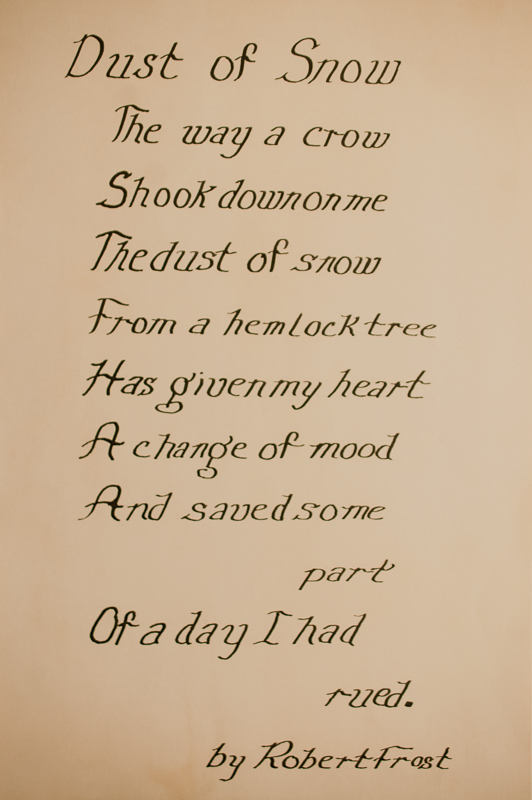
In my youth, I made this calligraphy, “Dust of Snow”.  My mom guided me in the process. Her love for the poetry of Robert Frost naturally influenced my choice of words. Having saved the original, she handed it over to me later in life.  I cherish it for posterity. Beautiful in all its imperfection, it reminds me of who I was, and the person I grew to be today.

DSC_4798-1
TiffanyCreek

Interruptions in Life

Reading can bring back memories, help to understand oneself with respect to the past, the present, and even give direction in life. It can stimulate the imagination and desire to create outside of a story, and make one’s own stories. “The Song of the Lark” strikes many such chords for me. Through Cather’s quiet introspective narrative tone, we watch the character, Thea Kronborg, grow into herself.

In Part II of the novel, Thea, with the encouragement of Doctor Archie, goes to Chicago to complete her musical education. While she takes piano lessons from Mr. Harsanyi, a Hungarian immigrant, she simultaneously sings in a choir for a church. Only by accident does Mr. Harsanyi discover that Thea is also a singer, possessing a beautiful, but untrained voice.

Life for Thea in the city takes on an aspect of drudgery and loneliness, feelings she never experienced growing up in Moonstone. She is the daughter of a Swedish minister and nonjudgmental mother, who believes in the power of fate. Back in Moonstone, Thea was a free-spirited girl, who carried around with her ‘under the cheek’ that inexplicable sense of innate happiness. Now in Chicago, that feeling has since dissipated, and been replaced by the routine of her music practice, and daily living.

One scene which recalls a memory for me is described in the opening passage of Chapter V, Part II:

By the first of February Thea had been in Chicago almost four months, and she did not know much more about the city than if she had never quitted Moonstone. She was, as Harsanyi said, incurious. Her work took most of her time, and she found that she had to sleep a good deal. It had never before been so hard to get up in the morning. She had the bother of caring for her room and she had to build her fire and bring up her coal. Her routine was frequently interrupted by a message from Mr. Larson summoning her to sing at a funeral. Every funeral took half a day, and the time had to be made up. When Mrs. Harsanyi asked her if it did not depress her to sing at funerals, she replied that she ‘had been brought up to go to funerals and didn’t mind’.

It’s this last scene that struck home with me, because I too was brought up going to funerals, to sing the Requiem. You see, the school I went to was attached to the Catholic Church. The best part of each classroom were the very large windows that looked out onto the grass and swing sets. The children could also watch the cars that drove by on the driveway, as they circled the school and the church. When there was a funeral the procession with the hearse and all the cars filled with mourning family members would also go by. This was our indication to go into the church and sing. We went to Mass every morning anyway, and sang in Latin, but when someone died, it was different. It was a solemn time, and we had to show the greatest respect.

Like Thea, going to sing for a funeral was not a task of drudgery, and even though I look back and realize it wasn’t what most normal children had to do, I didn’t mind. I enjoyed singing, that much, and looking at the beautiful stained glass windows inside the church. Similarly to Thea, these frequent interruptions to go sing at a funeral, were a real part of my school day life. As school children, it was our place to attend to the matter, give our voices to the sad family, and then get on with life. We learned to take the good, with the bad, and the sad, with the happy, and always had that something under our cheek to keep us company, even if it seemed to step out for awhile.

Although, I haven’t finished the story yet, I imagine that Thea has a lot of growing to do, that she will have to struggle even more; But if I know Willa Cather, her heroine will overcome, whatever steps in her way. Thea will undoubtedly be rewarded for her struggle, and be resurrected to an even more dignified level of being.