Window Art


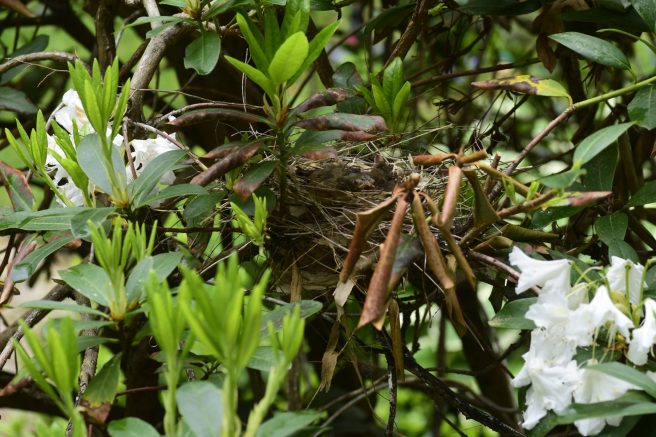
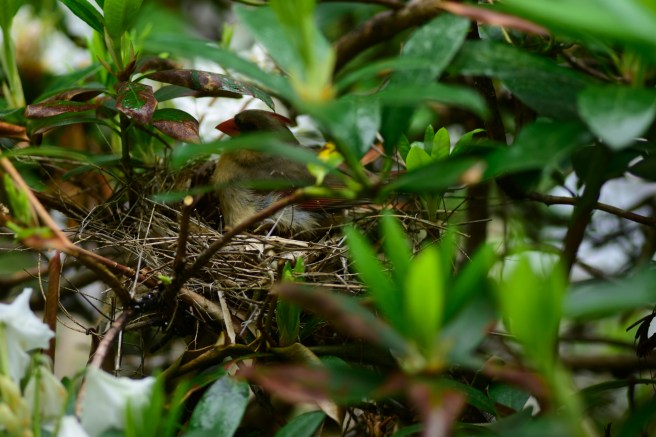
This Spring brought revelations from Nature. In early April the wings of two birds whizzed back and forth in fast motion in a Rhododendron, outside the kitchen window. Et voila!; A nest appeared. Within a few days a cardinal, lounging around in the concavity of straw and hay laid three small beige eggs, speckled with dark spots. They were visible from the upstairs window.
In previous seasons hatchlings were attacked and devoured by predators. But this year we were optimistic about the bird’s survival. The cardinal came daily to warm the eggs, which eventually hatched into three tiny breathing embryos. As the cardinal kept vigil over her tiny brood, the Redbird (male cardinal) came by to drop some nourishment into the cardinal’s beak. When the hatchlings developed into nestlings, the cardinal spent less time keeping them covered and provided them treats.
Several days passed when traces of wings emerged on the nestlings and black spots on their faces morphed into real eyes. Tiny talons were detectable. Day after day they got larger and larger and opened their beaks wider and wider, in apparent desperation to receive feedings from both the cardinal and the Redbird. Occasionally they flapped their wings.
When could they be called fledglings? I wondered. The answer came one morning when I looked down into the nest to see the sleeping birdies nestled in a perfectly circular shape, within the circumference of the nest. I thought I must take a picture. There was time! Wrong again! Looking out the kitchen window downstairs, the cardinal warmed her babies with the Redbird observing nearby. Suddenly I saw the cardinal stand on the edge of the nest and the Redbird drop bits of food into the very wide open mouths of his hungry brood. Unexpectedly, the Redbird and cardinal retreated. The nestlings flapped their wings, and one at a time they stretched their legs, stood on the edge of the nest and hopped down to the nearest branch. Once they were all out of the nest, but within the bush, in unison they flew away.
The cardinal and Redbird came back to the bush several minutes after the offspring fledged, seemingly in search of something they left behind. Later in the afternoon the Redbird foraged on the lawn, but the cardinal was no where to be found, and the fledglings were no where to be seen. A month later the cardinal and Redbird have come around the yard. It is hoped that since the babes flew the nest on April 17th that the parents have been giving them food and guidance in the forest. They say this can happen several days after the fledging.
Eleven days went by since the baby cardinals fledged. The nest had been vacant, until yesterday, when a pair of Robins brought mud and straw to the nest and vigorously ground and burrowed their bodies in the open space, as if preparing it for their own. I read that repurposing a nest is not a common practice, and that most birds prefer to build a new one. This must be the case because there has been no movement for a couple days now. I think it’s safe to say that the home of the baby cardinals is now an ‘Empty Nest.
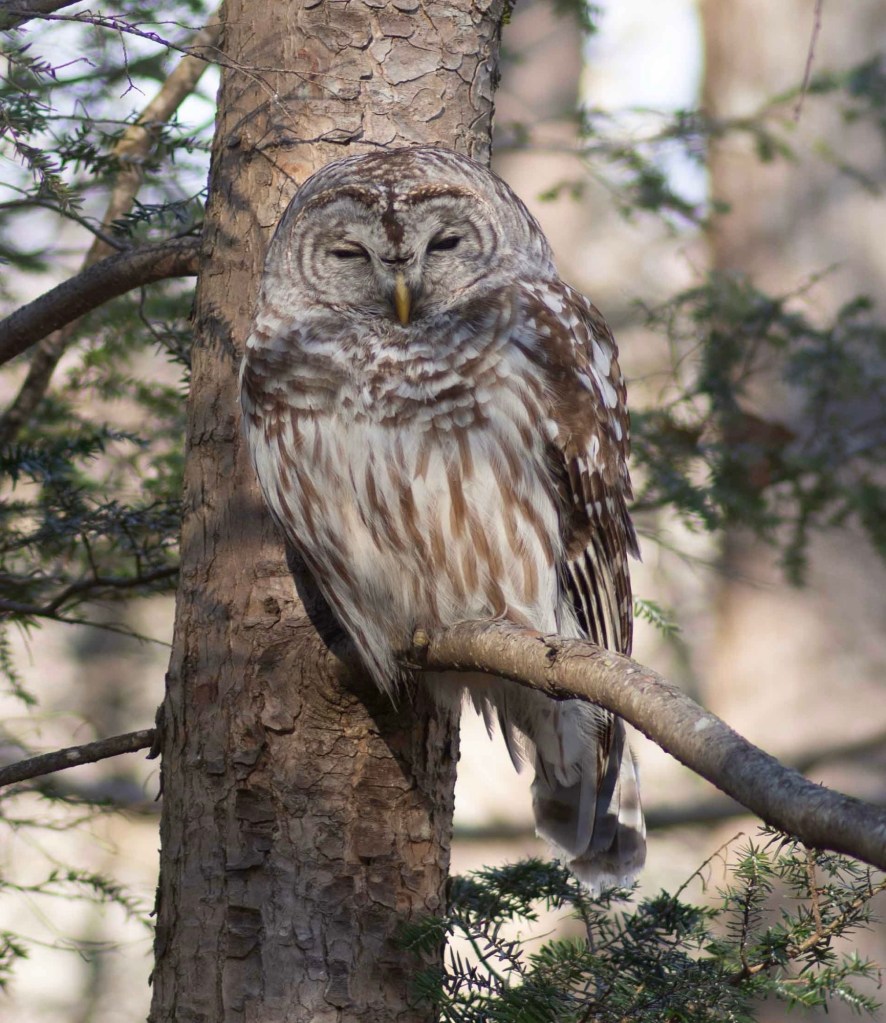
0ne early morning a sign of Spring appeared in the woods. It was a wise old owl who came to perch upon the limb of a tree not far from our house. He was rather quiet, except for a momentary eruption when he fanned his feathers, squawked and sent an intruding hawk on its way. Otherwise he slept throughout the day. Peace!
Please listen to the video from the next day. At the end of it you will hear the owl deep in the woods having his say.
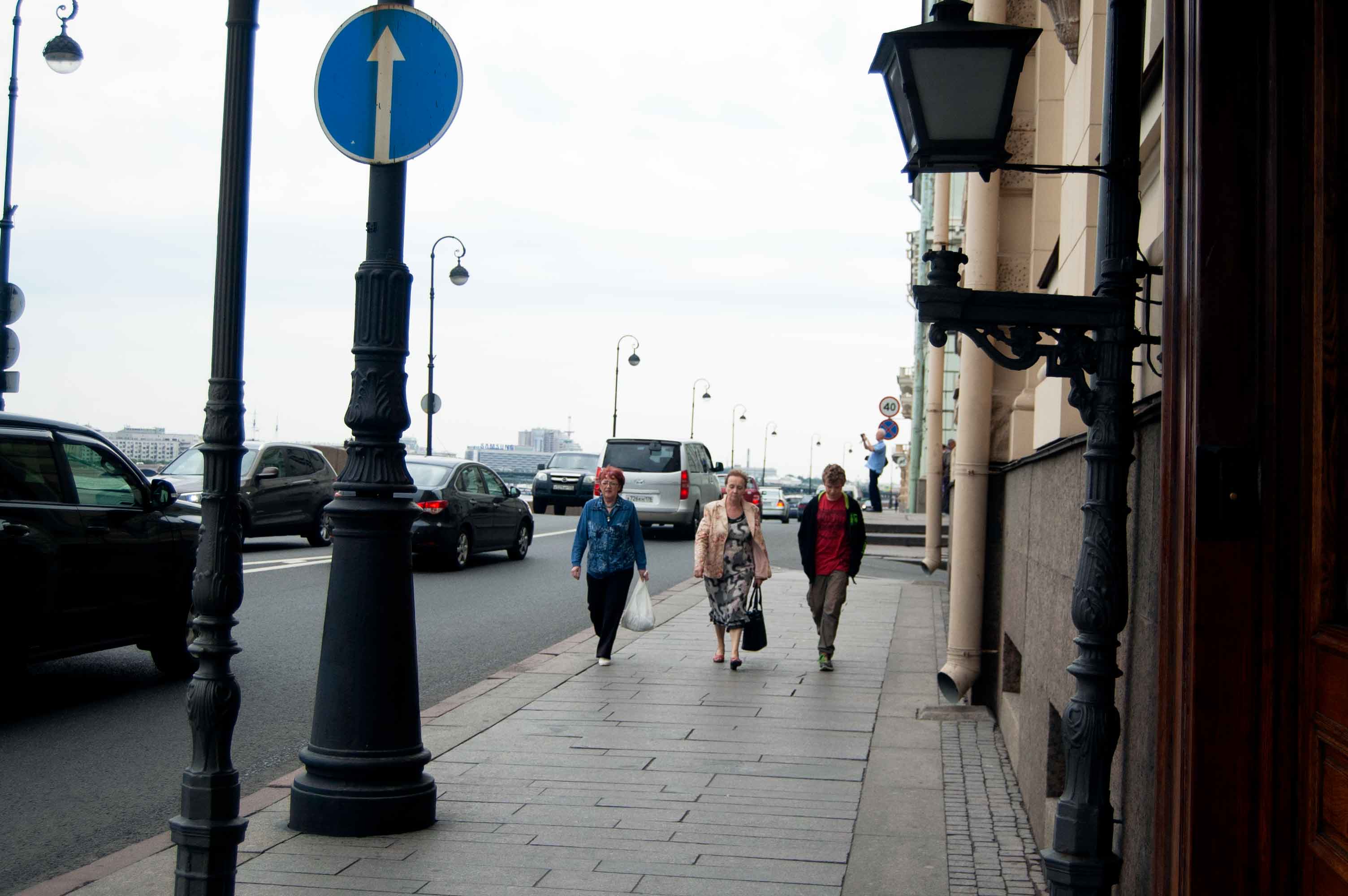
I arrived to St. Petersburg by ferry, from Helsinki, in 2015. I was scared. The ferry was Russian. I made a few Russian friends working in food service. We exchanged social media contact, but they disappeared from my radar when I got back to the U.S.A. Perplexing!
I took the featured photo at the time of my visit. The three: a young man in a red shirt, a woman in a dress, with a black bag, and a woman in pants, and a jean jacket, carrying a white plastic bag, are disengaged with each other, except they walk side by side. Could it be Mama, Grandma and Grandson? Possibly! Are they Russian? I thought so at the time. The man in the background taking a picture adds a touch of interest.
After a thought provoking trip, I made it back to Helsinki. The ferry didn’t gobble me up, but delivered me safely from one shore to the other, and back again. I do wonder though, whatever happened to my Russian friends from the ferry?
Ah, yes, sweet content of mind. How do you get to this place? To some it may come naturally as a part of their DNA. Some of us need to work harder at it. When we practice equanimity we may come closer to having ‘sweet content of mind.’ They are one in the same, or as we also say, ‘peace of mind.’
Reading gives me a feeling of equanimity. In reading a photo essay today entitled “Orwell’s Greenwich,” by Peter Robert’s, I learned details about George Orwell and was reminded of two of his books which I read in high school, “1984” and “Animal Farm.” The photo essay, through images followed the time that George Orwell lived in Greenwich, London. Orwell was a self-proclaimed socialist, but he didn’t necessarily appreciate left-wingers. He was happiest going to the pub and spinning yarns with the commoners. He fought in the Spanish Civil War, because he believed in the cause. He struggled with tuberculosis. Another person mentioned in this essay was Benjamin Waugh, because he lived in the same neighborhood as Orwell. The essay showed a photo of a plaque on Crooms Hill in London commemorating this man as the founder of the National Society for Prevention of Cruelty to Children. This plaque can remind people passing by of how to make the world a better place, and to regard children well. ‘All children want is to be included.’
The essay reminds us that Orwell began “1984” with the following line, “It was a bright cold day in April and the clocks were striking thirteen,” and that this sentence echoes Charles Dickens’ opening words to “The Tale of Two Cities,” “It was the best of times, it was the worst of times.” Because life is essentially about imbalance, and disequilibrium, don’t we all search for ways to make everything OK, especially at the beginning of a New Year? In this new year, I hope everyone finds sweet content of mind, a sense of equanimity and peace of mind. If not for a second.

“One doesn’t discover new lands without consenting to lose sight of the shore for a very long time. “
André Gide

Green leaves move in the trees.
The sun shines.
A cool breeze brushes my face.
A child at play.

A shell collection I picked up on the beach over time. A few I bought at a store. I like the broken and scuffed up imperfections of those found at the shore. Shells are wonderful concrete objects from nature with a variety of shapes and forms. Once they are in my pocket, rescued from the beating waves that tumble them on the sand, they can finally find a home where they exist intact, and impermeable to change. They will last longer than me. I keep them inside a giant glass fish bowl.


Port Orford, Oregon
Educating the mind without educating the heart is no education at all.
– Aristotle
There must be those among whom we can sit down and weep and still be counted as warriors. – Adrienne Rich

 On Tiffany Creek