Flight

The little Robins fledged in the night. Showing all signs of readiness, I wasn’t surprised. But wait! Did I see something stir? Lo and behold, the bush shook and a tiny beak emerged from inside; it was a lone runt who had not made the flight. Then Mother Robin (MR) appeared at the edge of the nest with worms, coaxing the little one to survive.

The runt spread her wings trying to flee, but with no-one to clamor over, or to act as a stepping stone to the outside, she would have to fight. On her own! MR returned with more worms. I hesitated to take out my camera for she was skittish and flew away when I did so. Mustn’t interfere with Mother Nature’s progress.

I’ve witnessed instinctual diligence unfold for 24 days, since the first of June when one of the four beautiful blue eggs was laid. MR’s dedication is a lesson for life. Day after day, she showed up at the nest. She laid one egg each day. The labor of incubation took time but once they were hatched she never gave up. She perched herself on the nest, sitting, feeding and hovering over her young in sunshine and in pouring rain. I believe she will not abandon the nest until her final babe takes flight.

New events! Later in the day, with a glance of the eye, I detected a fluttering within the lawn. By gum by golly, it was a fledgling. I thought, “did the little bird fly?” I ran to the second floor to find she was still in the nest, so the one on the lawn had to be a sibling. Where were the other two? So hot it was I set out a small bird bath for the fledgling’s mom and dad, who were roaming around the grass. I also turned the sprinkler on, which I think they liked.

Next day…

At the close of the day, I wondered what I would find when I awoke. With the rising sun my fledgling friend was still on the lawn and the little one, still in the nest.

Father Robin watched over the fledgling nestled in the fronds of the grass, while MR continued her task of nurturing her birdie in the nest. The male Robin thus far had been quiet, appearing every so often to assist his mate, but now his job was really cut out for him; to keep a watchful eye on the fledgling prancing around in the grass. The development of the fledgling to fly can take up to a week.

The works of nature are slow and gradual. Have you ever seen a flower close at the end of the day, or open at Dawn? With patience and observance we can witness Nature’s wonders. What happened with the nest outside my window is no coincidence. It was built in April by a set of Cardinals, who also raised in it a brood, and whose fledglings flew. In early June it was repurposed by these Robins. To take over another nest is an unusual behavior for birds.

Being able to view the beginning of this nest reminds me there is no end to the process of birth and renewal. Nature is an elixir to the cruelty and madness we are experiencing in the political world. All things must come to pass. Birds will keep singing, and Robins and Cardinals will keep making nests. Good will remain.

As I finish this essay the fledgling outside my window found the strength to hoist herself on the edge of the nest. She has been sitting there for the past hour and a half. In no hurry to roam too far, she opens her beak, and takes in the world around her. The question is, how long will she stay? One thing is for sure, I think this nest has had it. Happy birding!
To Russia With Love

I arrived to St. Petersburg by ferry, from Helsinki, in 2015.  I was scared. The ferry was Russian. I made a few Russian friends working in food service. We exchanged social media contact, but they disappeared from my radar when I got back to the U.S.A. Perplexing!

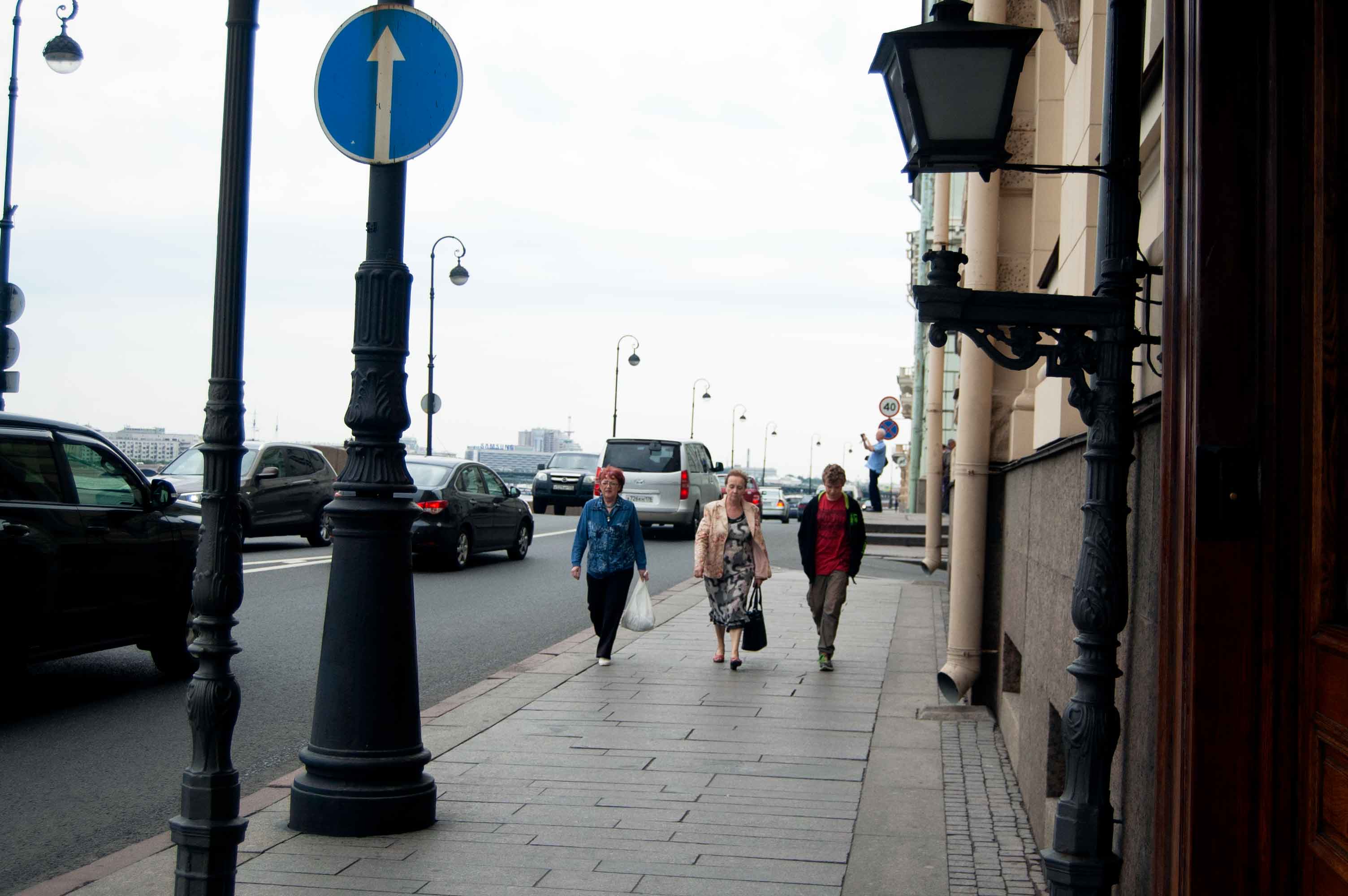
I took the featured photo at the time of my visit. The three: a young man in a red shirt, a woman in  a dress, with a black bag, and a woman in pants, and a jean jacket, carrying a white plastic bag, are disengaged with each other, except they walk side by side. Could it be Mama, Grandma and Grandson? Possibly!  Are they Russian?  I thought so at the time.  The man in the background taking a picture adds a touch of interest.   

After a thought provoking trip, I made it back to Helsinki. The ferry didn’t gobble me up, but delivered me safely from one shore to the other, and back again. I do wonder though, whatever happened to my Russian friends from the ferry?

A Book I Loved

The Novel, “Remarkably Bright Creatures,” kept me on the edge of my chair. Stirring me to tears through the last 3 chapters, RBC is about loneliness and loss. Shelby Van Pelt’s main character Tova, is an elderly woman of Swedish ancestry who in her janitorial duties at an aquarium in Washington state, loves and cares for Marcellus, an aging octopus. It turns out the octopus through his soliloquies and cunning behaviors, helps Tova and the reader see the truth; that her son Erik thirty some years before, who lost his life in a boating accident, couldn’t have killed himself like everyone in the town were rumored to believe. A young man named Cameron, from Southern California, comes to the town where Tova lives in search of the father he never knew, only to find that the truth is not as simple as he thought. This novel brings together a mix of unforgettable characters of every day walks of life I grew to love. They feel like real people from the lower echelons of society, struggling to make ends meet, each defining their unique purpose in life. Tova is the strong individual who teaches us that doing things the proper way matters in life and that relationships with humans and even an octopus are the reason for our being on this planet. This is a story of how human beings are supposed to be; how actions speak louder than words.

For Mankind… Really ?

What historical event fascinates you the most?

The landing on the moon, July 20th 1969, and the ability of the media to broadcast it over national television, is an historical event that is etched prominently in my memory. Neil Armstrong, Buzz Aldrin and Michael Collins made the voyage to the moon in the vessel called Apollo 11.

But why the moon? It was a challenge by JFK to put a man there, before the decade ended. Other reasons too, I suppose. For the advancement of science, and to send the message to Russia that the US was bigger and better than them.

Other events took place in 1969, such as the Woodstock concert, and the advent of Sesame Street, not to mention the invention of the internet, at least according to Google.

The landing on the moon “A Giant Leap” ended a turbulent decade in the US, whereby Race Riots and the War in Vietnam engulfed the psyche of the country, and mounting tensions across the land, and still do today. For some people, anyway.

By the end of the 60’s I was moving into my teenage years, and still, current events influenced to a degree, my fragile development. I came from a social, and politically minded family. I had a brother in Vietnam. My father, a liberal minded man who fought as a foot soldier in WWII, and my mother, an art teacher, all influenced my upbringing. And I had six siblings to bounce ideas and feelings off of, on a daily basis.

So, I witnessed the events of the 60’s with the newspaper in my hand, and listened to my parents in their adult fashion express their dismay, skepticism, and hopes for the future. Yet, despite my privileged upbringing emphasizing the importance of having an open mind, I ponder, where has that “Giant Leap for Mankind” brought us fifty-four years later, in 2023? Has it all been for humankind? How much was salvaged, how much was thrown away?

Yet, most of all, I look back at the landing on the moon with curiosity and wonder, because the moon has so many poetical possibilities; a source of human emotions since time began, and a symbol of positive power and creativity. In my mind, the moon will always represent Hope and Love. When they launched a rocket and put a man on there, I question, how many saw it the same way?

All Together

NOT LOST BUT GONE…
Sometimes a poorly exposed photograph is worth the effort. In this case I was able to bring back the memory of three small children, in a small way. Here we have the grave of Little Mary Smith (1865), Little Fannie, and Little Someone Else. The inscriptions were hard to read, but with a bit of tweaking, I was amazed how the letters and words become clearer, until “Voilà!” You have a phrase.
Plainfield, Connecticut August 26, 2016

Dream the impossible dream.

A friend of mine, interested in reading Don Quijote de la Mancha, wondered if anyone wanted to join her in the quest. Being a good friend, I said “Yes!”  In the vein of a true masochist I delved into the pages of this very old book, and reintroduced myself to the genius of Miguel de Cervantes – to his complex use of the Spanish language and natural wit to recreate the dreamy character, Don Quijote de la Mancha.

I remember the story fairly well.  DQ, off on a mission to reconstruct his life as a knight in shining armor, is in reality the opposite from what he conjures in his mind – a middle aged decrepit old man who has gone mad reading too much literature: stories like “El Mio Cid” and “Amadís de Gaula,” depicting heroes of the Spanish Medieval Age.  Don Quijote emulates everything about these characters, and aims to be like them.

In chapter two, Don Quijote, departs from his humble abode to travel under the heat and dryness of the day.  Cervantes satirically wrote: (my own translation)  “The sun ardently beat down forcefully, enough to melt the brains of anyone, if they had them at all.”   In his travels, DQ comes upon a castle, and of course he arrives wondering why he is not received with regal pomp, and circumstance.  In search of a place to rest his head he’s greeted by the keeper using words reminiscent of the piqued sarcasm of Cervantes, and paints a picture of life that is far from luxurious:  “the beds of your honor will always be hard rocks and your hours of sleep, forever wakeful.”  It’s a warning of the worst to come, for the knight-errant who just began his journey, carries only visions of grandeur in his head.

DQ continues his journey in Chapter 3, riding his skinny horse named Rocinante, on the look out for his fairly unkempt princess, Dulcinea. Soon he meets his fat and faithful side kick, his ‘escudero’ Sancho Panza.  Sancho is a faithful companion. Traveling with Quijote throughout the story, Sancho tries to convince his lord of Reality, but the hopeless Don Quijote insists on dreaming the impossible dream.

My friend and I soon concurred that perhaps we wouldn’t read the WHOLE book, in one fell swoop, for we have much else to do, but we’ll honor Cervantes in creating this great masterpiece, and plan to return to the story, in some shape and form, for to abandon Don Quijote is to abandon the truth he sought.  So like Sancho Panza, we will in spirit accompany Don Quijote through his journey, to pursue the impossible dream, for it’s the journey of all of us, and aren’t we all together, in this quest?


March

Before it goes out like a lamb, it’s time to talk about the month of March.  Looking back in history we’ll remember this month, in 2020, as the time when the Coronavirus grew exponentially in the U.S.A.  Not that we weren’t forewarned, by the explosion taking place in Europe, preceded by China, and Iran, etc., etc.. in previous weeks. Covid-19’s here to stay for a long time; forty five days until we see a peak, eighteen months before life goes back to normal, if it ever does.  In the long haul a positive outcome to this situation can be found within ourselves; find ways to beat it psychologically, remain optimistic, and use it to be more creative and productive in our personal lives.  Take up painting, the piano, reading novels, writing as much as we can.  How can we reach out, and help others, and bring them into our lives?  What special talents do we have that we can share?  There are certainly people living in a more precarious habitat, in which I’m living.  Selfishly I hope I don’t catch the virus, or be a carrier and less selfishly, pass it on to someone else.  So, where do we go from here? The answer seems to be nowhere, nothing versus something, and now being never.  What is true is we are all vulnerable.  No-one is exempt.

Back to March.  What do we know about this third month of the calendar year, which during Roman Times was the first, and not the third of the year?  A month named after the god of war, called Mars. Special days in particular yearn to be celebrated.  Such as St. Patrick’s day, on the 17th, especially by the Irish, but even if you haven’t an ounce of Irish in your blood, you’re always welcome to partake in Irish generosity.

On the 15th of March, back in Roman Times, an old woman warned Julius Caesar, “Beware the Ides of March.”  Against his wife’s best wishes Caesar ignored the oracle and ventured out into the Roman forum only to be assassinated, and find moments before he fell to his death that his best friend had betrayed him; thus the famous quote “Et tu Brutus?”  The circumstance is a reminder to follow the wisdom of Shakespeare spoken in one of his plays “Love all, trust a few, and do wrong to no-one.”  And, in the wake of the Corona19, to listen to the oracle; Stay home, protect yourselves, and others.

Since I am a curious person, who seeks novelty in all things possible to brush away the the sins of idleness, and boredom, I have a trivia fact for March.  Does anyone know what September, October, November and December stand for?  I found this out the other day through a post by the Farmer’s Almanac.  The meaning of the prefixes of these months in latin follow suit with March being the first month of the year, for Sept means seven, Octo, eight, Nove, nine, and Dece, ten.  So whatever happened to January and February?  There is an answer, but at this moment, I can only say; “I do not know it.”  Just like there are answers surrounding the mysteries of the Coronavirus, but for now uncertainty reigns, and only time will tell.