Green leaves move in the trees.
The sun shines.
A cool breeze brushes my face.
A child at play.


Green leaves move in the trees.
The sun shines.
A cool breeze brushes my face.
A child at play.
What historical event fascinates you the most?
The landing on the moon, July 20th 1969, and the ability of the media to broadcast it over national television, is an historical event that is etched prominently in my memory. Neil Armstrong, Buzz Aldrin and Michael Collins made the voyage to the moon in the vessel called Apollo 11.
But why the moon? It was a challenge by JFK to put a man there, before the decade ended. Other reasons too, I suppose. For the advancement of science, and to send the message to Russia that the US was bigger and better than them.
Other events took place in 1969, such as the Woodstock concert, and the advent of Sesame Street, not to mention the invention of the internet, at least according to Google.
The landing on the moon “A Giant Leap” ended a turbulent decade in the US, whereby Race Riots and the War in Vietnam engulfed the psyche of the country, and mounting tensions across the land, and still do today. For some people, anyway.
By the end of the 60’s I was moving into my teenage years, and still, current events influenced to a degree, my fragile development. I came from a social, and politically minded family. I had a brother in Vietnam. My father, a liberal minded man who fought as a foot soldier in WWII, and my mother, an art teacher, all influenced my upbringing. And I had six siblings to bounce ideas and feelings off of, on a daily basis.
So, I witnessed the events of the 60’s with the newspaper in my hand, and listened to my parents in their adult fashion express their dismay, skepticism, and hopes for the future. Yet, despite my privileged upbringing emphasizing the importance of having an open mind, I ponder, where has that “Giant Leap for Mankind” brought us fifty-four years later, in 2023? Has it all been for humankind? How much was salvaged, how much was thrown away?
Yet, most of all, I look back at the landing on the moon with curiosity and wonder, because the moon has so many poetical possibilities; a source of human emotions since time began, and a symbol of positive power and creativity. In my mind, the moon will always represent Hope and Love. When they launched a rocket and put a man on there, I question, how many saw it the same way?


It is morally as bad not to care whether a thing is true or not, so long as it makes you feel good, as it is not to care how you got your money as long as you have got it.
Edwin Way Teale, “Circle of the Seasons: The Journal of a Naturalist’s Year”
The time will come when, with elation
You will greet yourself arriving
At your own door, in your own mirror,
And each will smile at the others welcome,
And say, sit here.
Eat.
You will love again the stranger who was yourself.
By Derek Walcott
My friend Sally sent me this poem several month ago. I take it as a message to make peace with oneself. Before we forgive others, we must forgive ourselves.
Another version of this theme is found in a jingle my mom taught to me when I left her house one day. It goes like this:
I’ve gone out to look for myself, if I should return before I get back, keep me here.
And finally a quote by David Bowie:
Aging is an extraordinary process whereby
You become the person you always should have been.”
I like David’s quote because we race through life trying to figure out what we want to be and do when we grow up, only to realize that our true selves were within us all the time. I like to relive the idyllic aspects of my childhood and re-create them whenever I can. Things like chasing butterflies and collecting crickets for that much loathed science project you had to do at the beginning of every school year. I hated jabbing those pins into the thoraces of those poor insects and sticking them on cardboard poster board. Egads! then you had to label them. I went back to chasing butterflies instead and looking at wildflowers in the field, and consequently failed the school assignment. I’m happy I failed, because to this day I can come back to myself and the child that lives within, and say:
This is who I was, this is who I am. GRB
Robin Wall Kimmerer in her book “Braiding Sweetgrass” (2013 Milkweed Editions, Canada) incorporates indigenous wisdom and scientific knowledge to teach us about the world of plants. Her writing is poetic and like a prayer or chant, gently guides the reader through her prophetic thought. In the chapter called ‘Three Sisters’ Robin explains the relationship of beans, corn and squash as they grow together in the garden. When the English came to the New World they were perplexed by the native’s tendency to grow their plants in groupings instead of rows. As it turned out these groupings were based on the native’s experience that together, plants such as beans, corn and squash, flourish in a symbiotic relationship, and engage and share nutrients with their roots in the soil. Their reciprocal communication evolves naturally once their seeds grow to form vertical foliage, and flowers and fruits. They eventually not only give to each other but to the planter who inserted them in the earth to begin with. As an example, plants need nitrogen to grow and the nitrogen provided by the air isn’t enough so beans, characteristic of legumes, reaching into the sky, have the ability to draw nitrogen down into the soil benefitting not only them but the corn and squash that share their space. The beauty of the Three Sisters, represented in color by green for beans, yellow for corn and orange for squash is also founded in a native legend which describes how when the people were dying of hunger three beautiful women came to visit the village in colored garb. Symbolically they represented the three plants that eventually fed the people and saved them from famine. Kimmerer goes on to explain that each of the vegetables alone does not provide the necessary nutrients for a complete meal, but when eaten together, provide the perfect balance of vitamins and nutrients needed for a balanced diet. Kimmerer’s writing exudes positivity and the virtue of Simplicity. In a prior chapter called “Epiphany in the Beans’ she begins with a quote: It came to me while picking beans, the secret of happiness. I realized from this quote that our everyday living entangles us in rushing around and overthinking, when if we would just slow down we can find the joy in the simple things. This may be getting off track a tad but the same idea came to me when I was at the grocery store packing my groceries. Feeling at peace with myself, I looked up at the cashier and said to her: “This is going to sound crazy to you but I really like to pack groceries.” She agreed it was a mindless task. Anyway, back to topic, the next time I go to the store I will be sure to load up on scrumptious greens beans, yellow corn, and orange squash to bring home for my next feast. In the meantime I shall carry on my reading of “Braiding Sweetgrass” as I know it’s bound to be filled with more, and greater wisdom.
The place felt a little contrived, in some respects. On the other hand lots of history on the Maine railway system was on display. Worth going to just for the car museum and older buildings saved from Olden days of Boothbay, Maine. Couldn’t take the train but got this cute video capturing the sound and excitement from an adult tour group bussed in from Wisconsin. They were having a blast.

Made a journey down a winding road, to see an old friend, and a dog named Luna. Near the ocean we stayed, watching the waves, come and go.
On the morning walk with the dogs at the beach, the tilting fence glistened in the sun, with sand at her feet, and budding rose bushes of the dunes scattered round.
Time was approaching the hustle and bustle of beachgoers.
The afternoon sun beat down, where the children frolicked at the shore, with mother and father at their sides. They built castles in the sand, unfettered by the rough play of canines of the early morn.
What was Luna thinking, as she lay at home?
Luna spent the day, dreaming of her four legged friends, from whom she would steal balls and sticks, and of how they rolled raucously in the sand.
Then a swim!
Daybreak returned and Mother Nature called Luna back out to play. Alone she could not go, so she got up and wagged her tail, and sniffed and licked the sleepy face of my friend, to start another day, all over again.
Wandering down a country road,
in search of clarity and purpose,
A man saw a barn.
It was a landmark in rural decline.
A place of broken dreams from the past.
The day was dismal, and stormy.
Forlorn thoughts clouded his mind.
He paused at the crossing,
and stood in the wind and the rain.
All around him, time was moving fast.
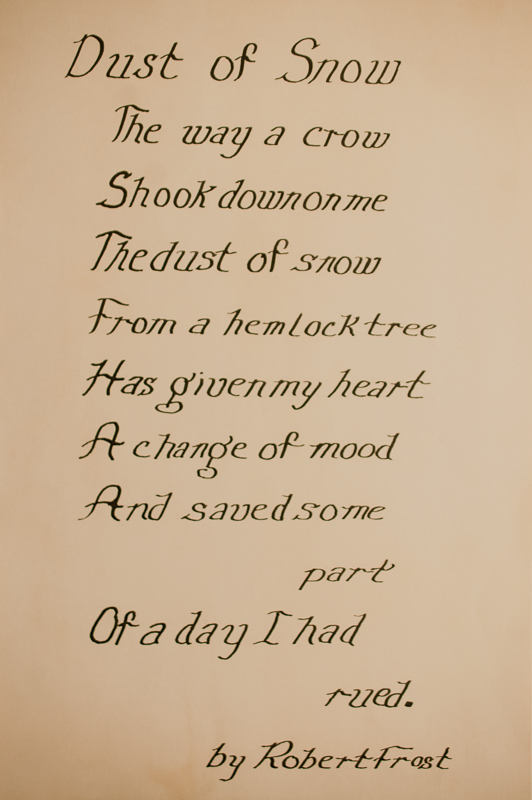
In my youth, I made this calligraphy, “Dust of Snow”. My mom guided me in the process. Her love for the poetry of Robert Frost naturally influenced my choice of words. Having saved the original, she handed it over to me later in life. I cherish it for posterity. Beautiful in all its imperfection, it reminds me of who I was, and the person I grew to be today.
Reading can bring back memories, help to understand oneself with respect to the past, the present, and even give direction in life. It can stimulate the imagination and desire to create outside of a story, and make one’s own stories. “The Song of the Lark” strikes many such chords for me. Through Cather’s quiet introspective narrative tone, we watch the character, Thea Kronborg, grow into herself.
In Part II of the novel, Thea, with the encouragement of Doctor Archie, goes to Chicago to complete her musical education. While she takes piano lessons from Mr. Harsanyi, a Hungarian immigrant, she simultaneously sings in a choir for a church. Only by accident does Mr. Harsanyi discover that Thea is also a singer, possessing a beautiful, but untrained voice.
Life for Thea in the city takes on an aspect of drudgery and loneliness, feelings she never experienced growing up in Moonstone. She is the daughter of a Swedish minister and nonjudgmental mother, who believes in the power of fate. Back in Moonstone, Thea was a free-spirited girl, who carried around with her ‘under the cheek’ that inexplicable sense of innate happiness. Now in Chicago, that feeling has since dissipated, and been replaced by the routine of her music practice, and daily living.
One scene which recalls a memory for me is described in the opening passage of Chapter V, Part II:
By the first of February Thea had been in Chicago almost four months, and she did not know much more about the city than if she had never quitted Moonstone. She was, as Harsanyi said, incurious. Her work took most of her time, and she found that she had to sleep a good deal. It had never before been so hard to get up in the morning. She had the bother of caring for her room and she had to build her fire and bring up her coal. Her routine was frequently interrupted by a message from Mr. Larson summoning her to sing at a funeral. Every funeral took half a day, and the time had to be made up. When Mrs. Harsanyi asked her if it did not depress her to sing at funerals, she replied that she ‘had been brought up to go to funerals and didn’t mind’.
It’s this last scene that struck home with me, because I too was brought up going to funerals, to sing the Requiem. You see, the school I went to was attached to the Catholic Church. The best part of each classroom were the very large windows that looked out onto the grass and swing sets. The children could also watch the cars that drove by on the driveway, as they circled the school and the church. When there was a funeral the procession with the hearse and all the cars filled with mourning family members would also go by. This was our indication to go into the church and sing. We went to Mass every morning anyway, and sang in Latin, but when someone died, it was different. It was a solemn time, and we had to show the greatest respect.
Like Thea, going to sing for a funeral was not a task of drudgery, and even though I look back and realize it wasn’t what most normal children had to do, I didn’t mind. I enjoyed singing, that much, and looking at the beautiful stained glass windows inside the church. Similarly to Thea, these frequent interruptions to go sing at a funeral, were a real part of my school day life. As school children, it was our place to attend to the matter, give our voices to the sad family, and then get on with life. We learned to take the good, with the bad, and the sad, with the happy, and always had that something under our cheek to keep us company, even if it seemed to step out for awhile.
Although, I haven’t finished the story yet, I imagine that Thea has a lot of growing to do, that she will have to struggle even more; But if I know Willa Cather, her heroine will overcome, whatever steps in her way. Thea will undoubtedly be rewarded for her struggle, and be resurrected to an even more dignified level of being.
 On Tiffany Creek