Cultivo una rosa

Cultivo una rosa blanca

en julio como en enero

para el amigo sincero

que me da la mano franca

y para el cruel

que me arranque el corazón

Cardo ni ortiga cultivo

Cultivo una Rosa Blanca.

Por José MartÍ

I cultivate a rose

in July as in January (Warm or cold, it matters not.)

For my sincere friend

who gives me his honest hand

and for the cruel one

Who pulls out my heart

Neither thistle nor thorn

do I cultivate.

I cultivate a white rose.

“Cultivo una rosa blanca” was written by José Martí, a patriot, poet and journalist, who fought to help liberate Cuba from Spanish rule and colonialism.

The poem, which I memorized eons ago came to me in the night as I tossed and turned to go back to sleep. Funny to have such a memory, but there is a reason for everything. Life can be a struggle and we move through it like water in a deep lake. Sometimes our movements in what ever form they should take are made without thought for the repercussions, or waves they make. Unbeknownst to ourselves, our actions and words may hinder the tender heart of someone whose silent pain we are unfamiliar with, but nonetheless our interactions are significant. We may be the honest friend at times who lends a hand or we may be the cruel friend who pulls out someone’s heart. The point of the poem is to be able to turn the other cheek and forgive, when we are the recipient of some else’s words or actions. The harder part is to realize when we are the one who causes the hurt, or anticipate it before it happens.

Pema Chodrön would say, we all need to lighten up and let it go, and act with kindness and compassion. And then there is the quote by Oscar Wilde, “morality is knowing where to draw the line.” This is a good measure to embrace, lest we should pull out the heart of someone we love, who may, or may not forgive us.

Love

A Book I Loved

The Novel, “Remarkably Bright Creatures,” kept me on the edge of my chair. Stirring me to tears through the last 3 chapters, RBC is about loneliness and loss. Shelby Van Pelt’s main character Tova, is an elderly woman of Swedish ancestry who in her janitorial duties at an aquarium in Washington state, loves and cares for Marcellus, an aging octopus. It turns out the octopus through his soliloquies and cunning behaviors, helps Tova and the reader see the truth; that her son Erik thirty some years before, who lost his life in a boating accident, couldn’t have killed himself like everyone in the town were rumored to believe. A young man named Cameron, from Southern California, comes to the town where Tova lives in search of the father he never knew, only to find that the truth is not as simple as he thought. This novel brings together a mix of unforgettable characters of every day walks of life I grew to love. They feel like real people from the lower echelons of society, struggling to make ends meet, each defining their unique purpose in life. Tova is the strong individual who teaches us that doing things the proper way matters in life and that relationships with humans and even an octopus are the reason for our being on this planet. This is a story of how human beings are supposed to be; how actions speak louder than words.

Close Encounters

A few weeks ago I recorded a pleasant encounter I had at the grocery store. My hope is that this story will add some positive vibes to the world

     I’m always impressed how encounters with new people can be so meaningful, and almost magical.  I had one such encounter in the grocery store this week.  While I was checking out a young Asian man stood right behind me.  We both did a double take because it was only two days prior that we were in exactly the same place together.  I reminded him, “We met here two days ago and you were buying a bag of King Arthur Wheat Flour and you were going to make cookies for your girlfriend who was visiting.”  He said “Yes, and here’s my girlfriend Sarah right here.”  I said, “Hello Sarah!”   Sarah smiled and said hello back.  Then I asked the young man how the cookies turned out and he said “Great!” and that they would make them again. I saw he was buying Tofu so I asked  him with all seriousness if he was going to make Tofu Cookies.  He laughed as if one doesn’t make Tofu Cookies, and said they would make something, but I didn’t catch the name. “A Korean dish,” he said. We conversed a little more and I managed to get them to tell me they were students – he at UCONN and Sarah at U of San Diego.  I said “Oh my son lives in San Diego.” Yet another coincidence.  I asked what he studied, and he said, “Economics.”  Then I asked Sarah, and she said, “Economics.”  As I proceeded to leave he asked me what my name was and I told him, and I asked what his name was, and he said “Pin”, “Pin and Sarah” he said.  I said it was a pleasure to meet them.  We both agreed ours was a wonderfully joyful encounter and we hoped we would meet again.  I then left the store, with a memorable experience to take home.

It never ceases to amaze me when a magnetic charm takes hold in this world. Really, what were the chances that I would bump into the same stranger in the same place within two days of each other? And on top of it, have such a pleasant conversation. Since these two consecutive meetings, I haven’t run into Pin, or, at least I am not aware of our paths crossing. Though, it’s possible we have – and maybe we will. Until then, let the magic of the world unfold.

The Little Flower Dies

florinda-dsc_5576-2
Photo courtesy of David Dreimiller

Florinda Udall, born in May 1833, died at age 11 years and 8 months, on January 25th, 1845. She was the daughter of Alva and Phebe Udall, from Hiram, Ohio, and had one brother, named Edward.  She was a schoolmate of Lizzie Atwood Pratt and Lucretia Rudolph Garfield.

Lizzie Atwood records the death of Florinda in her diary, on January 24th, 1845, which is in conflict with the death date, on the stone:  “I spent the evening at Mr. Boyds.  Florinda Udall one of my schoolmates died of Bowel Complaint, after 6 days illness AE 11 years, and 8 months.” On the 26th she writes:  “Florinda was buried at the center of Hiram.”  The diary entry is true to the tone of Lizzie’s writing, which was matter of fact, and sparing of emotion.  This was the style of most of her writing.  At 12 years of age, she proved to be an objective observer of events that took place around her, in her village, and does this as well, in the case of Florinda’s illness and death.

Florinda’s name, comes from the word ‘flora,’ meaning ‘flower’ in Spanish, and is derived from Latin.  It must have been sad for family and friends, when their little flower died.

“A Day In The Life of Luna” ~ Revised

DSC_1592-1
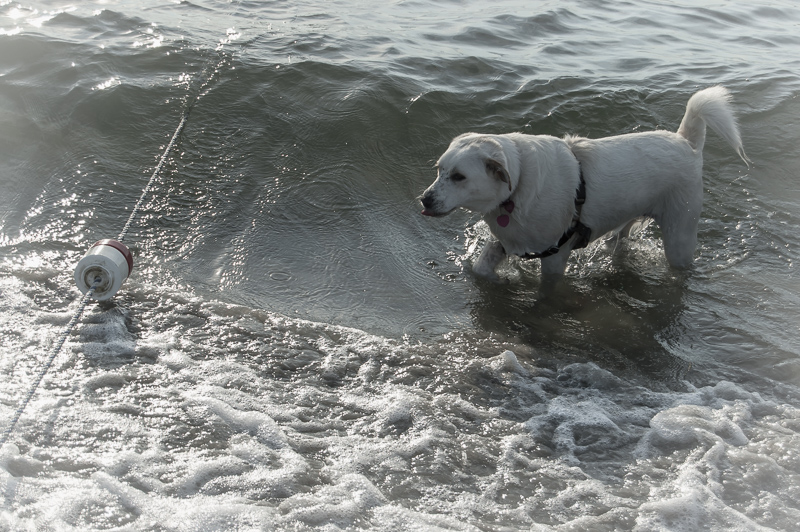
Luna, at the Sea

Made a journey down a winding road, to see an old friend and a dog named Luna. Near the coast we stayed.  We listened to the not so distant waves come and go, in a rhythmic way.  The smell of salt was in the air.

The next morning, on a walk at the beach, the tilting fence post glistened in the sun, with sand at its feet. Budding rose bushes, splattered bits of red color upon the dunes.  The dynamic sea awaited the hustle and bustle of beachgoers, after Luna and her friends had their play.

In the afternoon, the sun beat down. Children frolicked at the shore with mother and father at their sides, building castles in the sand.  They felt unfettered, by the rough canine play, of the early morn.

What did Luna think, as she lay at home sleeping, mid-day?  There, she was dreaming of her four-legged pals, from whom she would steal balls and sticks, as they raucously rolled in the sand.  Then, swim!

In the hours, when the night had fallen, and twilight awoke, daybreak returned to summon Luna out to play.  Alone, she could not go. She rose, wagged her tail, and sniffed and licked the face of my sleepy friend.  She was begging to go to the ocean, where she would find her friends again; and so they did.

With every journey, there is something to be learned. On this one, it was knowing a day in the life of Luna, and the simple pleasures it brings.


Luna

DSC_1592-1
Luna, at the Sea

Made a journey down a winding road, to see an old friend, and a dog named Luna.  Near the ocean we stayed, watching the waves, come and go.

On the morning walk with the dogs at the beach, the tilting fence glistened in the sun, with sand at her feet, and budding rose bushes of the dunes scattered round.

Time was approaching the hustle and bustle of beachgoers.

The afternoon sun beat down, where the children frolicked at the shore, with mother and father at their sides.  They built castles in the sand, unfettered by the rough play of canines of the early morn.

What was Luna thinking, as she lay at home?

Luna spent the day, dreaming of her four legged friends, from whom she would steal balls and sticks, and of how they rolled raucously in the sand.

Then a swim!

Daybreak returned and Mother Nature called Luna back out to play.  Alone she could not go, so she got up and wagged her tail, and sniffed and licked the sleepy face of my friend, to start another day, all over again.

Without Friends

Summer's Secrets
Summer’s Secrets

Summer’s secrets

hold much in store…

frolicking, playing, and more

Sadness, and storms, with thunder and lightening,

Keeping one up

it’s quite frightening.

Life and death are fare game…

Without friends

it wouldn’t be the same.

For my friends by TiffanyCreek

Struggling to Understand

Thoughts on an article from the St. Paul Pioneer Press, Sunday, August 17, 2014

IGHGrampa writes about ‘struggling to understand issues of Life (and Death)’. He reflects upon the suicide of Robin Williams, saying he had everything a person could possibly want, so how could he possibly want to take his life? Perhaps he has a point, but, many would ask, who is to judge? This point of view reminds me once, when I actually took the attitude, that if someone wants to kill themselves, it is alright. Today, I think twice before making this judgement, and it all stems back to when Someone, somewhere, when I lived in Nebraska, had taken their life. I don’t remember who they were, but it was someone, a coworker of mine and I were talking about one day, at a cafe, or bar. What I do remember, is my conversation with this very attractive blond girl, younger than myself. I really liked this girl a lot.  I think it was her very strong character and the self-confidence, with which she projected herself. In reference to this suicide, I said something to the effect, that it was this person’s decision to do what they wanted with their life, whether it was to continue on, or end it by their own hands. What will never leave my memory, is this girl’s totally unexpected, and strong reaction to my statement. With her steel blue eyes, she looked into, my eyes, and told me point blank; “It’s wrong!” She was adamant and unwavering in her statement, and went on to say that it was a totally selfish act, and that this person had no regard for the feelings of others around him or her. She was so fixed in her opinion that it truly made me stop and think about the act of suicide. To this day, and with utmost respect, I think of the proud and moral position this girl took, and I admire her still, for standing her ground on an issue, about which many people were, and still are, wishy washy. Furthermore, she was young, in the years of the late 70’s, a time when, ‘everything goes’. Today, I shame myself for not having a stronger spine and for following the opinion of the flock.

Going back to the article, IGHGrampa goes on to talk about ‘the struggle’, so to speak. He makes reference to the main character of the movie “Precious”, a woman who seems to have “insurmountable” problems. He writes about the struggle by astronomers to acquire knowledge and an understanding of how the planets and stars are formed, the forces of existence itself.

Pondering these struggles, Grampa remarks on his own trivial struggles, and that ‘sometimes you just have to put the struggles aside for a time.’ He even works on his own little problems in his workshop, to help him forget about the larger struggles of the world. Or, he likes to simply listen to classical music, to escape. His final statement makes so much sense to me, and that is, that perhaps, in order to understand, the key is ‘to make an effort to remove oneself from the struggle’, someway, somehow.

Grampa’s words bring me back to the idea of the struggle, to choose life, or death, between what is right, and what is wrong. In light of these thoughts, it is our duty, to find something that can be done for those, who find themselves alone in a moment of desperation, something to prevent them from hurting themselves, and/or others, whether it be with words, actions, or no action.  The passive-aggressive route. To help them to make an effort to ‘remove themselves from the struggle, and carry on in this world of life and death.  If my blond friend were here today, she would know. She would know what to say, and do.

Presently, I am thankful that this girl stepped into my life, if only for a short time. Like a few people in my life, she is gone, hopefully living, nonetheless, out of my radar.  Yet, the spirit of her hopefulness, has not subsided.  When the question of suicide ever comes up, I think of this girl, who worked by my side, in Lincoln, Nebraska, and, I think twice.