
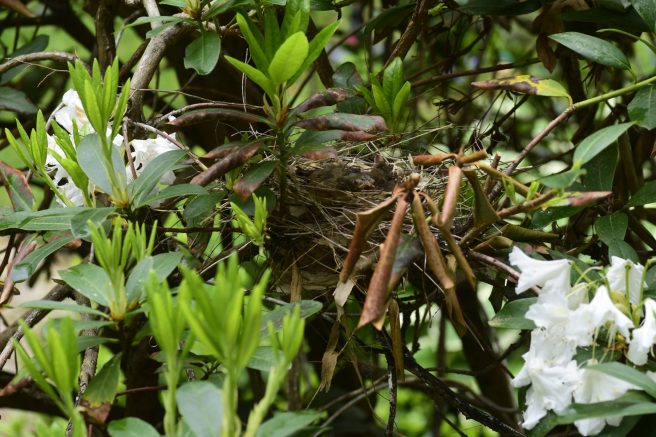
The little Robins fledged in the night. Showing all signs of readiness, I wasn’t surprised. But wait! Did I see something stir? Lo and behold, the bush shook and a tiny beak emerged from inside; it was a lone runt who had not made the flight. Then Mother Robin (MR) appeared at the edge of the nest with worms, coaxing the little one to survive.
The runt spread her wings trying to flee, but with no-one to clamor over, or to act as a stepping stone to the outside, she would have to fight. On her own! MR returned with more worms. I hesitated to take out my camera for she was skittish and flew away when I did so. Mustn’t interfere with Mother Nature’s progress.
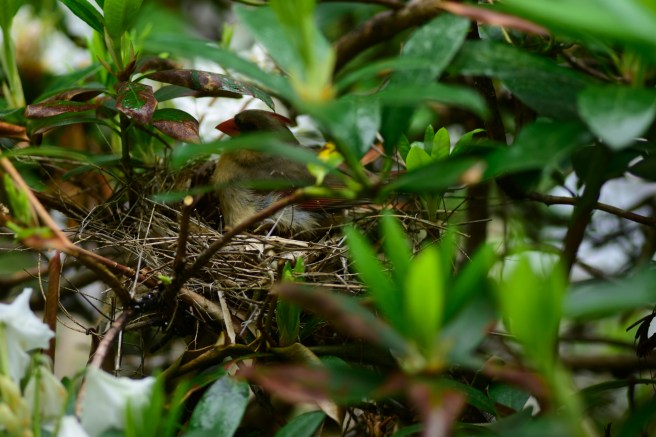
I’ve witnessed instinctual diligence unfold for 24 days, since the first of June when one of the four beautiful blue eggs was laid. MR’s dedication is a lesson for life. Day after day, she showed up at the nest. She laid one egg each day. The labor of incubation took time but once they were hatched she never gave up. She perched herself on the nest, sitting, feeding and hovering over her young in sunshine and in pouring rain. I believe she will not abandon the nest until her final babe takes flight.
New events! Later in the day, with a glance of the eye, I detected a fluttering within the lawn. By gum by golly, it was a fledgling. I thought, “did the little bird fly?” I ran to the second floor to find she was still in the nest, so the one on the lawn had to be a sibling. Where were the other two? So hot it was I set out a small bird bath for the fledgling’s mom and dad, who were roaming around the grass. I also turned the sprinkler on, which I think they liked.
Next day…
At the close of the day, I wondered what I would find when I awoke. With the rising sun my fledgling friend was still on the lawn and the little one, still in the nest.
Father Robin watched over the fledgling nestled in the fronds of the grass, while MR continued her task of nurturing her birdie in the nest. The male Robin thus far had been quiet, appearing every so often to assist his mate, but now his job was really cut out for him; to keep a watchful eye on the fledgling prancing around in the grass. The development of the fledgling to fly can take up to a week.
The works of nature are slow and gradual. Have you ever seen a flower close at the end of the day, or open at Dawn? With patience and observance we can witness Nature’s wonders. What happened with the nest outside my window is no coincidence. It was built in April by a set of Cardinals, who also raised in it a brood, and whose fledglings flew. In early June it was repurposed by these Robins. To take over another nest is an unusual behavior for birds.
Being able to view the beginning of this nest reminds me there is no end to the process of birth and renewal. Nature is an elixir to the cruelty and madness we are experiencing in the political world. All things must come to pass. Birds will keep singing, and Robins and Cardinals will keep making nests. Good will remain.
As I finish this essay the fledgling outside my window found the strength to hoist herself on the edge of the nest. She has been sitting there for the past hour and a half. In no hurry to roam too far, she opens her beak, and takes in the world around her. The question is, how long will she stay? One thing is for sure, I think this nest has had it. Happy birding!


 On Tiffany Creek