
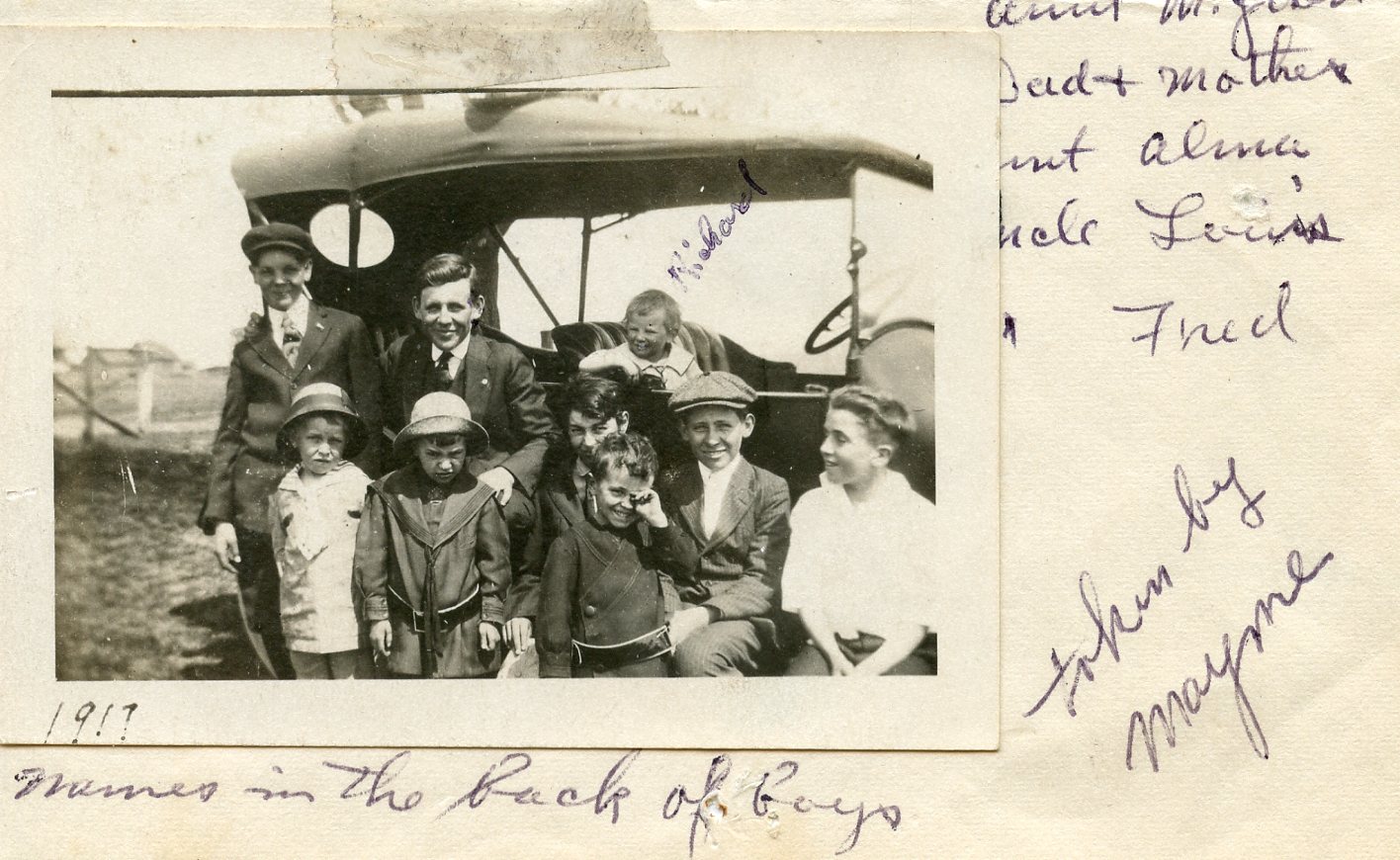
Why do people chase down their ancestors, pouring through letters and documents with frayed edges, faded ink on sheets of paper which crumble in your hands and between your fingers? I guess the answer is in the question. As we strive for a paperless society, documents become exceedingly inaccessible, buried in forgotten computer files, the World Wide Web, the Cloud, or Google docs and PhotoShop. Our memory is also buried in these files – gone! – and the danger of obliterating the personal handwritten accounts which affirm the history of our ancestry, becomes more and more imminent. Long gone is the autograph book and rapidly disappearing is the hand written letter and journal as witnesses of times past. Whatever primary sources resurface in twenty-five, fifty or seventy five years, will certainly be an anomaly, if they exist at all.
Our pursuit of knowledge and wonder are no longer driven by hiking on trails through wooded hills, along running brooks, or on cobblestone streets in historic towns, villages and countries, but rather, through endless hours with our eyes pasted to a computer screen. Perhaps the advent of the iThis and iThat, and the capability to transmit and receive information instantly through time and space is our way of staying in tune as we are constantly on the move, whether it’s sitting in a chair in our living room or in the seat of a train. Yet we need not remember a thing, because all information is at our fingertips through technology, and although we are seemingly more cerebral and introverted in our social exchanges, we pursue, record and process information at a faster pace than we ever did before – only to be forgotten.
We are living in an era of heightened individualism and guarded privacy which has made us less sociable face to face, more suspicious, paranoid and worried about what one knows about us and if it is really an apt description of who we are. In this state of agitation we are unable to shift our consciousness into a true state of Carp Diem, or in other words, lose ourselves completely in a moment of time, in the beauty of a poem, the shapes and forms of a painting, or in the seconds at dusk and dawn when the buds of a flower open and close.
As the Age of Technology spins out of control what legacy will we be leaving for our children which our foremothers and fathers have left for us? I for one find myself sucked into this technology and forever striving to keep up and constantly learning how to use it – dependent on the keyboard for my social interaction and to satisfy my wonder and pursuit of information. Yet, I am weary and discerning of the lack of reality and authenticity of technology and unsatisfied with the information it has to offer. I am afraid the layers of facts, or facts posing as the truth which are deeply buried in my computer will be quickly forgotten when I turn off the switch. Yet I am happy to know that this information will never compare with the real photographs, authentic documents and letters which I hold in my hand. I consider myself fortunate and at the same time saddened to have these papers at my fingertips because I realize that their production is a thing of the past.
 On Tiffany Creek