The day is waiting! Dawn passed before I awoke, and the sun is getting too bright for comfort. Alas, one mustn’t begrudge the sunshine, though there is nothing like a rainy day to set thoughts in motion.
Having awakened with a clean slate, alongside one of many chores, and things to do, I ask, “Which will prevail? Meandering my way through unprescribed discovery, or following the rule of accomplishment, and purpose?” Balance is the prudent course.
To open the day, here is a poem by a Finnish artist, named Eeva Lisa Manner (1921-1995). The title, “ASSIMILATION”
Assimilation that I have travelled. I will show you a way that I have travelled. If you come If you come back some day searching for me do you see how everything shifts a little every moment and becomes less pretentious and more primitive (like pictures drawn by children or early forms of life: the soul’s alphabet) you will come to a warm region it is soft and hazy but then I will no longer be me, but the forest.
Human relationships are the tragic necessity of human life; that they can never be wholly satisfactory, that every ego is half the time greedily seeking them, and half the time pulling away from them.
In the early afternoon, I found myself potting plants eager to get them in their new place to grow and flourish. The sun was taking its toll on me, in addition to feeling quite tired after a not so good nights sleep and some cold like symptoms mimicking allergies. As I sat down to read Isabel Allende’s novel, “La isla bajo el mar”, I stopped to think, “how did my day begin?”- for the life of me I could not remember. Then suddenly, I did an, “Ah yes!” – In the morning I took a detour to the university to pick up the textbook I would be using to teach a new course in the fall – thinking about how to plan and organize the class syllabus, I opened the book and checked the Table of Contents – I say to myself, “aha! – 14 chapters – I will have to ‘cover’ seven. But what should I include? I have to calculate the number of classes, make up a calendar and decide what’s important – grammar is important, but I don’t want to kill with the drill, so I will emphasize conversation and culture. All students want to speak and learn about culture.” Oh, it was all so mind boggling at the moment and I really didn’t want to start a calendar in Word, so I set to reading the text’s first short story, “Águeda”, by Pío Baroja, (1872-1956).
The story has all the makings of a fairy tale without the happy ending, – it goes like this -Águeda is a young Spanish girl with a mother and a couple of sisters. She is ugly and has a physical deformity. While her sisters and her mother go out and seem to be enjoying life, Águeda sits at home, at a window overlooking a plaza in Madrid, doing “encaje”, which is a type of Spanish embroidery done on small pillows with bobbins and thread. Out of courtesy her sisters invite her to the theatre from time to time, but Águeda knows she is a social misfit and politely declines with a smile by saying, ‘maybe some other night’. The story takes an interesting turn. A lawyer friend of the family begins to visit the house. He talks with Águeda and is amazed at how attentive she is to what he has to say. He comes back again and again to converse with Águeda and she begins to fall in love with him. One day he asks her if she would like it if he became a member of the family. Águeda becomes so excited with this offer she can’t believe her ears. Then he says, “I have asked your father for the hand of your sister Luisa”. Águeda’s world crumbles around her – she locks herself in her room and cries all night. Her sister Luisa tells her of the good news and asks Águeda to embroider the pillows for her matrimonial bed. Águeda of course doesn’t oppose and sets to her task. As Baroja puts it; ‘Águeda dreamed of having a husband and children but knew she was destined to having a miserable life. If she didn’t break out crying while she did her embroidery it was because she did not want to leave imprints in the material from her tears.’ As time went on Águeda had moments of hope and thoughts that someday a young man would enter her life and love her, but as she looked down into the plaza and saw the many young men from all walks of life passing by, a scream welled up inside her. Águeda was left only with the memory of her desire for her first and last love.
As we hear the story we might think in our day and age, – how ridiculous! Things are never so bad, we all have a place in this world, and there is someone out there for everyone. Today our society is just and takes care of people with special supports. We are a happy people and there is a solution for everything. Yet, “Águeda”, a Cinderella story in reverse – an Ugly Duckling tale, without a happy ending, makes us stop and think of people who never fit in because of this or that abnormality, hidden or overt. The people around Águeda reveled in their happiness while Águeda sat in silence withholding her tears and appeared seemingly content with her place in life. Are there people with whom we interact everyday, who don’t fit in, but cover there sadness with so-called happiness?
The story was short and when I finished I was reminded of how dark, sad and morose literature from Spain can be and asked myself, “does it have to be so?”, and the answer was – “Yes!”. In order for the reader to have empathy for Águeda and learn a lesson, the purpose of all Spanish literature, Baroja had to tell the not so happy truth. He was not protecting the reader who wants to evade reality by reading fairy tales. The story’s universality strikes home even in modern times as we live in a society of ultra positive thinking in which an exaggerated sense of elation is a put on to mask the sadness which endures below the surface.
With the onset of the new semester, I will teach the story of “Águeda”. My students will read in Spanish and they will struggle with the meaning, so I will explain the words using synonyms and antonyms. Together, we will make up situations and give examples, draw comparisons and find contrasts, and hopefully, after all that, we will understand and reach out to the Aguedas who roam the world and perhaps, just maybe, realize, we all have some of Águeda within us, at some point in time.
A reading of “The Dubliners” will make you marvel at James Joyce’s poetic prose and caricature of various personages as they roam through the streets of this city. It makes one want to get on a plane and go to Ireland. I downloaded these stories gratis on my iphone with ibooks. Since I always have my phone I am never without a good story to keep me company.
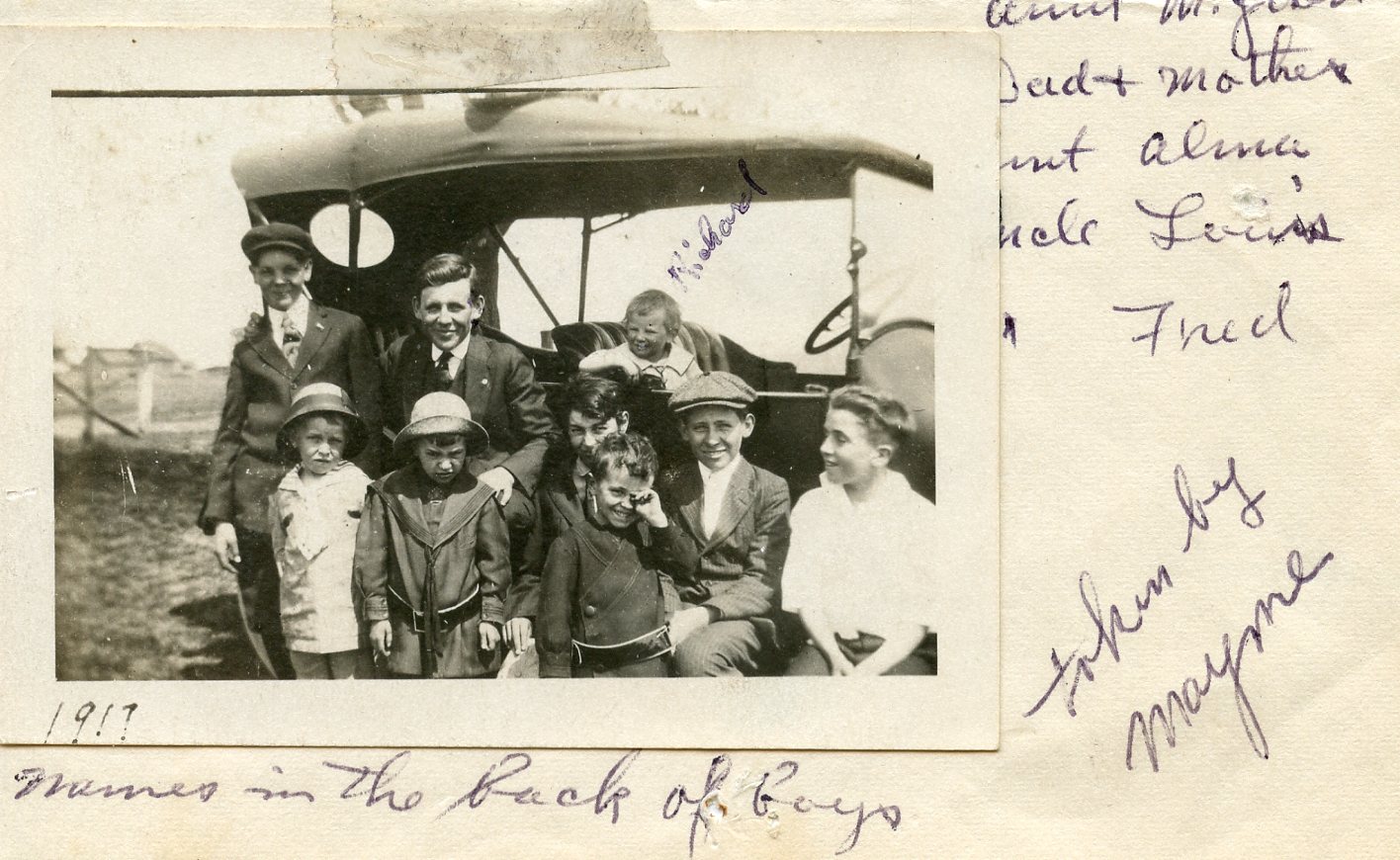
Why do people chase down their ancestors, pouring through letters and documents with frayed edges, faded ink on sheets of paper which crumble in your hands and between your fingers? I guess the answer is in the question. As we strive for a paperless society, documents become exceedingly inaccessible, buried in forgotten computer files, the World Wide Web, the Cloud, or Google docs and PhotoShop. Our memory is also buried in these files – gone! – and the danger of obliterating the personal handwritten accounts which affirm the history of our ancestry, becomes more and more imminent. Long gone is the autograph book and rapidly disappearing is the hand written letter and journal as witnesses of times past. Whatever primary sources resurface in twenty-five, fifty or seventy five years, will certainly be an anomaly, if they exist at all.
Our pursuit of knowledge and wonder are no longer driven by hiking on trails through wooded hills, along running brooks, or on cobblestone streets in historic towns, villages and countries, but rather, through endless hours with our eyes pasted to a computer screen. Perhaps the advent of the iThis and iThat, and the capability to transmit and receive information instantly through time and space is our way of staying in tune as we are constantly on the move, whether it’s sitting in a chair in our living room or in the seat of a train. Yet we need not remember a thing, because all information is at our fingertips through technology, and although we are seemingly more cerebral and introverted in our social exchanges, we pursue, record and process information at a faster pace than we ever did before – only to be forgotten.
We are living in an era of heightened individualism and guarded privacy which has made us less sociable face to face, more suspicious, paranoid and worried about what one knows about us and if it is really an apt description of who we are. In this state of agitation we are unable to shift our consciousness into a true state of Carp Diem, or in other words, lose ourselves completely in a moment of time, in the beauty of a poem, the shapes and forms of a painting, or in the seconds at dusk and dawn when the buds of a flower open and close.
As the Age of Technology spins out of control what legacy will we be leaving for our children which our foremothers and fathers have left for us? I for one find myself sucked into this technology and forever striving to keep up and constantly learning how to use it – dependent on the keyboard for my social interaction and to satisfy my wonder and pursuit of information. Yet, I am weary and discerning of the lack of reality and authenticity of technology and unsatisfied with the information it has to offer. I am afraid the layers of facts, or facts posing as the truth which are deeply buried in my computer will be quickly forgotten when I turn off the switch. Yet I am happy to know that this information will never compare with the real photographs, authentic documents and letters which I hold in my hand. I consider myself fortunate and at the same time saddened to have these papers at my fingertips because I realize that their production is a thing of the past.
There is nothing like summer theatre and “The Odd Couple”, by Neil Simon, to take our minds off pending summer projects and step into another reality.
In this hilarious comedy, type A personality, Felix Unger, is booted out of the house by his wife Frances. To his good fortune, Oscar Madison, his slovenly poker playing friend, takes him under his wing. After living together for a short time as divorcees, Oscar and Felix discover they are extreme incompatible opposites. What happens in the “Odd Couple” is that Felix, a neatnik, can’t stand to see anything out of its place and begins to drive Oscar nuts with all his nitpicking ways.
We soon realize that the result is not more order but chaos when Felix’s compulsive behavior is imposed upon Oscar’s happy go lucky nature. Oscar is virtually going insane and Felix once again finds himself out on the street only to be taken in by the British Pigeon sisters. Once Felix leaves, peace and harmony are ironically restored to Oscar’s life and “order” becomes a matter of opinion.
“The Odd Couple” appeals to us in so many ways. Set in New York City, it perfectly mirrors reality and our own foibles. This wonderfully enjoyable play can teach us to strike a balance and live sanely with others, or at best, just let things be.


 On Tiffany Creek