“Águeda”, and What I Did This Morning

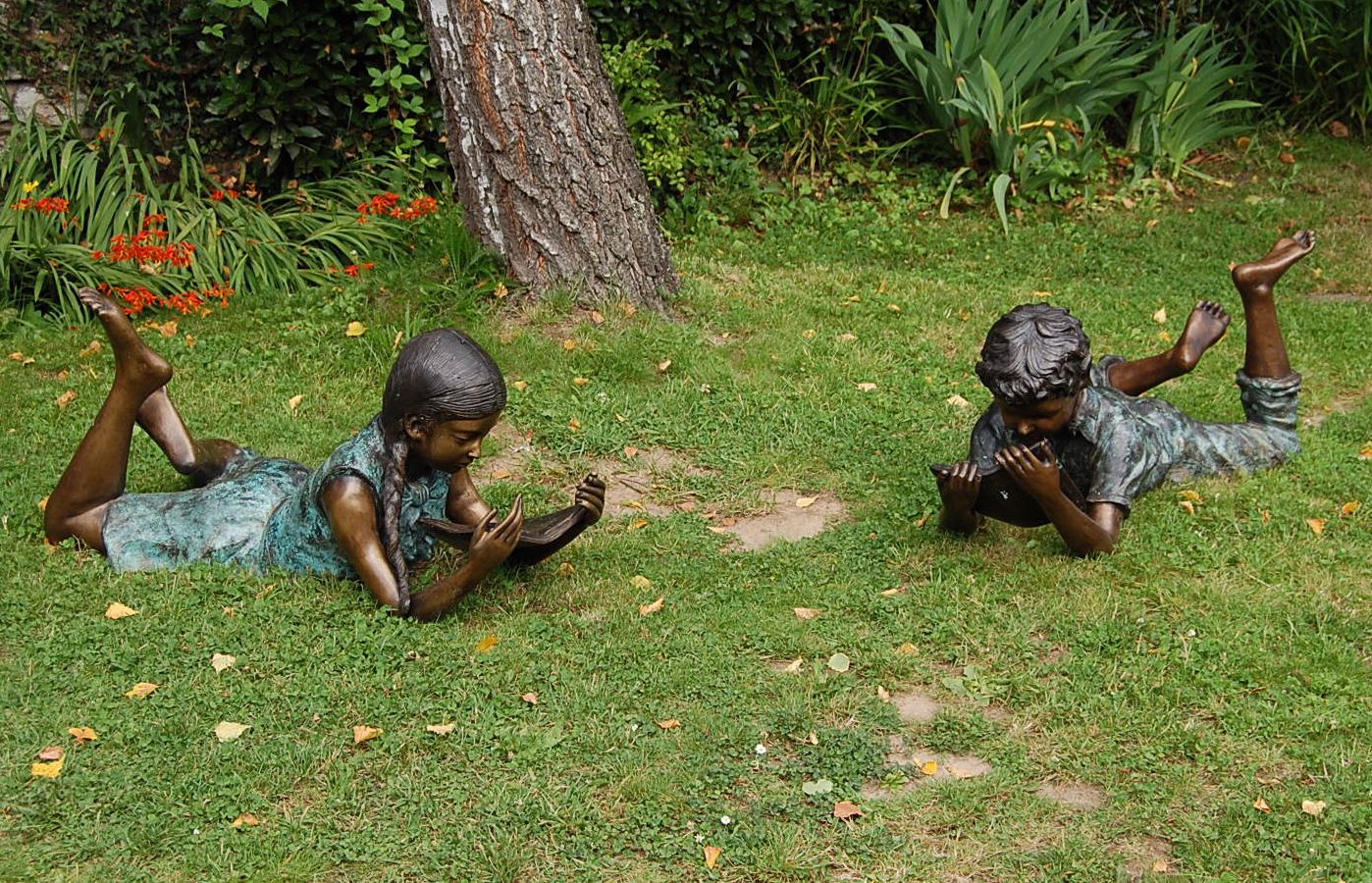
‘Readers of Villedieu’, Normandy, France

In the early afternoon, I found myself potting plants eager to get them in their new place to grow and flourish.  The sun was taking its toll on me, in addition to feeling quite tired after a not so good nights sleep and some cold like symptoms mimicking allergies.  As I sat down to read Isabel Allende’s novel, “La isla bajo el mar”, I stopped to think, “how did my day begin?”- for the life of me I could not remember.  Then suddenly, I did an, “Ah yes!” – In the morning I took a detour to the university to pick up the textbook I would be using to teach a new course in the fall – thinking about how to plan and organize the class syllabus, I opened the book and checked the Table of Contents – I say to myself, “aha! – 14 chapters – I will have to ‘cover’ seven. But what should I include?  I have to calculate the number of classes, make up a calendar and decide what’s important – grammar is important,  but I don’t want to kill with the drill, so I will emphasize conversation and culture. All students want to speak and learn about culture.”  Oh, it was all so mind boggling at the moment and I really didn’t want to start a calendar in Word, so I set to reading the text’s first short story, “Águeda”, by Pío Baroja, (1872-1956).

The story has all the makings of a fairy tale without the happy ending, – it goes like this -Águeda is a young Spanish girl with a mother and a couple of sisters.  She is ugly and has a  physical deformity.  While her sisters and her mother go out and seem to be enjoying life, Águeda sits at home, at a window overlooking a plaza in Madrid, doing “encaje”, which is a type of Spanish embroidery done on small pillows with bobbins and thread. Out of courtesy her sisters invite her to the theatre from time to time, but Águeda knows she is a social misfit and politely declines with a smile by saying, ‘maybe some other night’.  The story takes an interesting turn.  A lawyer friend of the family begins to visit the house.  He talks with Águeda and is amazed at how attentive she is to what he has to say.  He comes back again and again to converse with Águeda and she begins to fall in love with him.  One day he asks her if she would like it if he became a member of the family. Águeda becomes so excited with this offer she can’t believe her ears.  Then he says, “I have asked your father for the hand of your sister Luisa”. Águeda’s world crumbles around her – she locks herself in her room and cries all night.  Her sister Luisa tells her of the good news and asks Águeda to embroider the pillows for her matrimonial bed. Águeda of course doesn’t oppose and sets to her task.  As Baroja puts it; ‘Águeda dreamed of having a husband and children but knew she was destined to having a miserable life.  If she didn’t break out crying while she did her embroidery it was because she did not want to leave imprints in the material from her tears.’  As time went on Águeda had moments of hope and thoughts that someday a young man would enter her life and love her, but as she looked down into the plaza and saw the many young men from all walks of life passing by, a scream welled up inside her. Águeda was left only with the memory of her desire for her first and last love. 

 As we hear the story we might think in our day and age, – how ridiculous! Things are never so bad, we all have a place in this world, and there is someone out there for everyone. Today our society is just and takes care of people with special supports. We are a happy people and there is a solution for everything. Yet, “Águeda”, a Cinderella story in reverse – an Ugly Duckling tale, without a happy ending, makes us stop and think of people who never fit in because of this or that abnormality, hidden or overt.    The people around Águeda reveled in their happiness while Águeda sat in silence withholding her tears and appeared seemingly content with her place in life.   Are there people with whom we interact everyday, who don’t fit in, but cover there sadness with so-called happiness?

The story was short and when I finished I was reminded of how dark, sad and morose literature from Spain can be and asked myself, “does it have to be so?”, and the answer was – “Yes!”.  In order for the reader to have empathy for Águeda and learn a lesson, the purpose of all Spanish literature, Baroja had to tell the not so happy truth.  He was not protecting the reader who wants to evade reality by reading fairy tales.   The story’s universality strikes home even in modern times as we live in a society of ultra positive thinking in which an exaggerated sense of elation is a put on to mask the sadness which endures below the surface.  

With the onset of the new semester, I will teach the story of “Águeda”.  My students will read in Spanish and they will struggle with the meaning, so I will explain the words using synonyms and antonyms.  Together, we will make up situations and give examples, draw comparisons and find contrasts, and hopefully, after all that, we will understand and reach out to the Aguedas who roam the world and perhaps, just maybe, realize, we all have some of Águeda within us, at some point in time.


Notes On A Chinese Artist’s Lecture

Art is more than just proportion and likeness.  An artist’s energy and motion are connected to the model at all times.  The artist must have the mental toughness to go slowly and analyze the structures and points, get involved in the process little by little.  Define the underlying structure and observe the geometric shapes.

Once the structure is understood shadows as shapes and proportions are rendered before adding details such as lines, wrinkles, hair.  Each line the artist puts down becomes part of the drawing whether it is erased or not, it is still there.

Drawing with emotional involvement, what you feel, defines the beauty of the form, emphasizing the muscular features.  Use imagination to portray a hero or heroine, wretch or a rogue.  Pay attention to the tension in the various parts of the model’s shape.  Look for angles, new and interesting perspectives.

To inform your craft, look at how models are interpreted in drawings and paintings in museums, libraries outside the studio.  Research is an essential component of learning to draw.  Read about different philosophies and styles of drawing.  Try to emulate others work without losing your own identity and authentic style.

Notes taken at a lecture by Qimin Liu, Art professor at Eastern Connecticut State University.

“Keeping Our Small Boat Afloat”

“So many blessings have been given to us

During the first distribution of light, that we are

Admired in a thousand galaxies for our grief.

Don’t expect us to appreciate creation or to

Avoid mistakes.  Each of us is a latecomer

To the earth, picking up wood for the fire.

Every night another beam of light slips out

From the oyster’s closed eye.  So don’t give up hope

That the door of mercy may still be open.

Seth and Shem, tell me, are you still grieving

Over the spark of light that descended with no

Defender near into the Egypt of Mary’s womb?

It’s hard to grasp how much generosity

Is involved in letting us go on breathing,

When we contribute nothing valuable but our grief.

Each of us deserves to be forgiven, if only for

Our persistence in keeping our small boat afloat

When so many have gone down in the storm.”

by Robert Bly

I died for beau…

I died for beauty, but was scarce
Adjusted in the tomb
When one who died for truth was lain
In an adjoining room.

He questioned softly why I failed?
“For beauty”‘, I replied
And I for truth – the two are one;
“We brethren are”, he said.

And so as kinsmen met a night,
We talked between the rooms,
until the moss had reached our lips,
and covered up our names.

By Emily Dickinson

“Winter”

Image

“Winter”

by Walter de la Mare

Clouded with snow

The cold wind blows,

And shrill on leafless bough

The robin with its burning breast

Alone sings now.

The rayless sun,

Day’s journey done,

Sheds its last ebbing light

On fields in leagues of beauty spread

Unearthly White.

Thick draws the dark,

and spark by spark,

The frost fires kindle, and soon

Over that sea of frozen foam

Floats the White moon.

At the end of the day

There’s another day dawning

And the sun in the morning is waiting to rise

Like the waves crash on the sand

Like a storm that will break any second

There’s a hunger in the land

There’s a reckoning still to be reckoned and there’s gonna be – to pay

At the end of the day!

James Joyce “The Dubliners”

A reading of “The Dubliners” will make you marvel at James Joyce’s poetic prose and caricature of various personages as they roam through the streets of this city.  It makes one want to get on a plane and go to Ireland.  I downloaded these stories gratis on my iphone with ibooks.  Since I always have my phone I am never without a good story to keep me company.

“Looper” A Summary

If you have seen the movie “Looper”, and aren’t quite sure what was going on, perhaps this summary will help to make some sense of it.  Some viewers have criticized it for having too many holes in the plot.  This may be true, but part of the intrigue in watching “Looper” is the challenge of tracking what is going on and trying to figure out, how characters and events relate to each other.  I am rather happy with my synopsis but open to remarks, so if you have already seen the movie, read this and let me know if it sounds about right, or not.  If you haven’t seen the movie and don’t mind a spoiler, I also recommend my summary.

“Looper”, extremely violent, is nonetheless an enlightening film of self- discovery and redemption. The excessive depiction of violent acts and pervasive drug addiction which keeps the audience on the edge of their seats, is necessary for transmitting the ultimate message that mankind must put an end to destruction and replace it with love, kindness and the preservation of innocence. The main character, Joe, played by Joseph Gordon-Levitt, is a heartless killer  – a looper, working for an evil leader in control of sending his foes back from the future to be assassinated by his entourage of hired murderers. Joe, like his friend Seth, fails to carry out his duty when he is faced with assassinating himself as he emerges out the ground from the future of 30 years later.  In botching his own assassination, Joe, and his future self, played by Bruce Willis, become fugitives running from the thugs controlled by the leader of the Ring.  When Joe realizes that his older self is out to destroy three young boys born on the same day in the same hospital because one of them could grow up to be the evil Rainmaker, he schemes to thwart the killing of one of these boys.

Bruce Willis, as Joe, tries to prevent the horror facing the future, which would be committed by the little boy Sid, if he’s allowed to grow into being the ultimate evil force in the world. In the final scene he is about to shoot the child’s caregiver, a beautiful intelligent blonde, who is blocking the boy with her body, so he can escape into the sugar stocks.  The younger Joe, arriving at the scene, envisions his older self Willis, shooting the blonde, who is really the sister of the boys mother, and sees the little boy in the future as he escapes through the fields and rides on a train, free to grow up to be a terrorist and assassinator. Instead of shooting his future persona, the younger Joe turns the gun on himself in order to break the vicious cycle and prevent the evil of the future from occurring.  Upon killing himself, the older Joe played by Willis, disappears into thin air and the young woman and the boy are saved. In his sacrifice, evil is restored by goodness and the cycle of destruction ends.  Joe, the heartless killer, in spirit, saves himself from committing future evil deeds and reinstates innocence embodied in the little boy.  For the audience, especially for the girls, he becomes a savior and hero to humanity.

Joseph Gordon-Levitt gives an Academy Award winning performance.  The humorous and playful actor that we know from Saturday Night Live, shows he is able to portray the evil villain and the loving nature of Levitt-Gordon’s character in 50/50 is again unveiled when Joe finds his true self in “Looper”.