Love creates a communion with life. Love expands us, connects us, sweetens us, ennobles us. Love springs up in tender concern, it blossoms into caring action. – Jack Kornfield
A love letter to Amelita.



☮️🩵💛🩵🙏🌙☪️

Love creates a communion with life. Love expands us, connects us, sweetens us, ennobles us. Love springs up in tender concern, it blossoms into caring action. – Jack Kornfield
A love letter to Amelita.
☮️🩵💛🩵🙏🌙☪️
What a mess it is, this world of AI
spinning on a carousel of Bots.
Can’t even talk to
a human on the spot.
Cast into the Net
and whirled around in jest..
Problems, never solved
Yet we are charged, just the same.
And end up talking to Samson in Nairobi
to fix an issue on the Plains.
How is a person to stay sane?
Spring arrives..

Blue Robin's eggs,
like the color of a crystal clear lake,
are laid.
Hatchlings grow and fledge.

Summer is here..

Raspberries and blueberries
with ice cream and tea
bring cheer.
Fall is near.
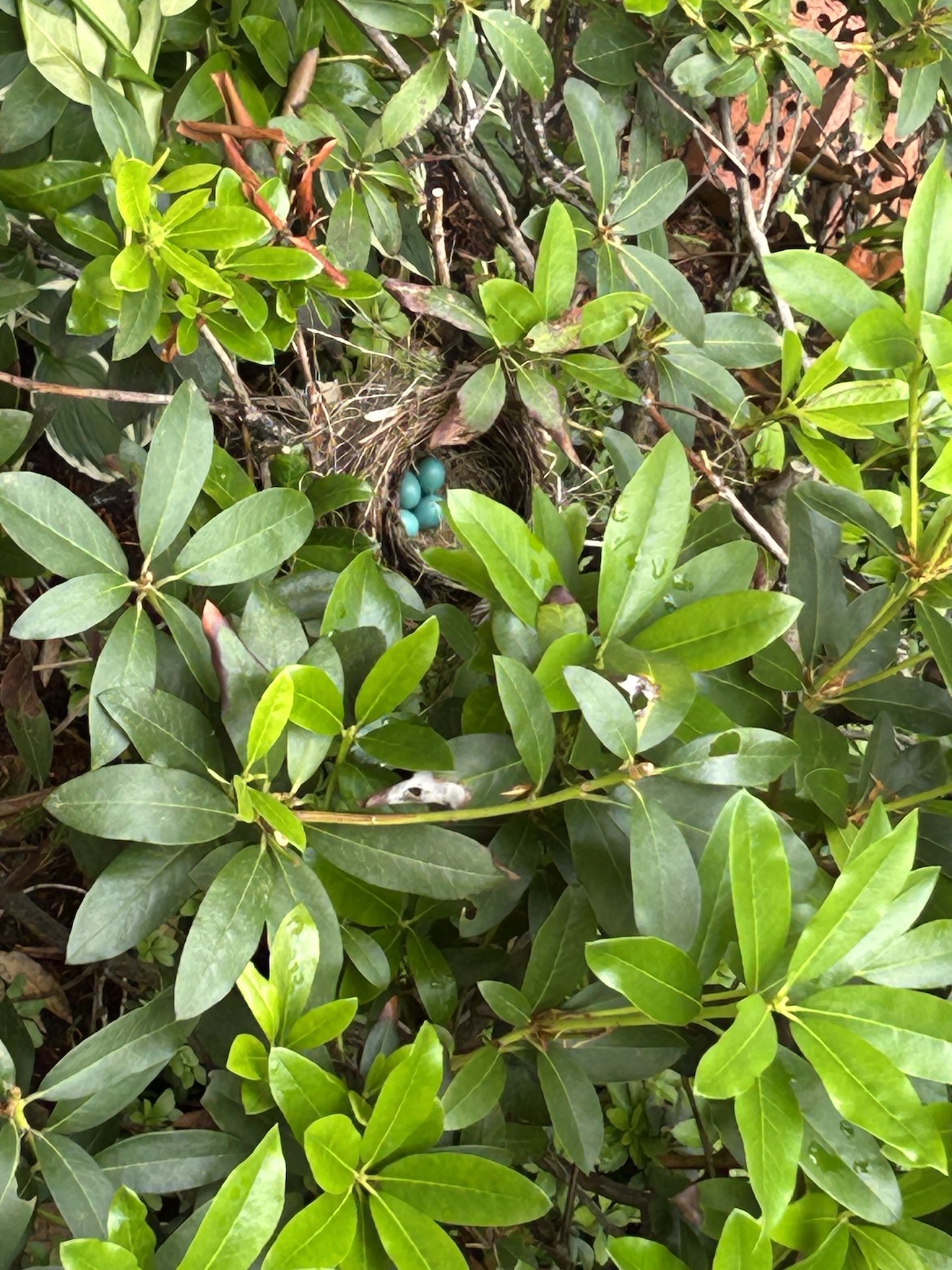
The little Robins fledged in the night. Showing all signs of readiness, I wasn’t surprised. But wait! Did I see something stir? Lo and behold, the bush shook and a tiny beak emerged from inside; it was a lone runt who had not made the flight. Then Mother Robin (MR) appeared at the edge of the nest with worms, coaxing the little one to survive.
The runt spread her wings trying to flee, but with no-one to clamor over, or to act as a stepping stone to the outside, she would have to fight. On her own! MR returned with more worms. I hesitated to take out my camera for she was skittish and flew away when I did so. Mustn’t interfere with Mother Nature’s progress.
I’ve witnessed instinctual diligence unfold for 24 days, since the first of June when one of the four beautiful blue eggs was laid. MR’s dedication is a lesson for life. Day after day, she showed up at the nest. She laid one egg each day. The labor of incubation took time but once they were hatched she never gave up. She perched herself on the nest, sitting, feeding and hovering over her young in sunshine and in pouring rain. I believe she will not abandon the nest until her final babe takes flight.
New events! Later in the day, with a glance of the eye, I detected a fluttering within the lawn. By gum by golly, it was a fledgling. I thought, “did the little bird fly?” I ran to the second floor to find she was still in the nest, so the one on the lawn had to be a sibling. Where were the other two? So hot it was I set out a small bird bath for the fledgling’s mom and dad, who were roaming around the grass. I also turned the sprinkler on, which I think they liked.
Next day…
At the close of the day, I wondered what I would find when I awoke. With the rising sun my fledgling friend was still on the lawn and the little one, still in the nest.
Father Robin watched over the fledgling nestled in the fronds of the grass, while MR continued her task of nurturing her birdie in the nest. The male Robin thus far had been quiet, appearing every so often to assist his mate, but now his job was really cut out for him; to keep a watchful eye on the fledgling prancing around in the grass. The development of the fledgling to fly can take up to a week.
The works of nature are slow and gradual. Have you ever seen a flower close at the end of the day, or open at Dawn? With patience and observance we can witness Nature’s wonders. What happened with the nest outside my window is no coincidence. It was built in April by a set of Cardinals, who also raised in it a brood, and whose fledglings flew. In early June it was repurposed by these Robins. To take over another nest is an unusual behavior for birds.
Being able to view the beginning of this nest reminds me there is no end to the process of birth and renewal. Nature is an elixir to the cruelty and madness we are experiencing in the political world. All things must come to pass. Birds will keep singing, and Robins and Cardinals will keep making nests. Good will remain.
As I finish this essay the fledgling outside my window found the strength to hoist herself on the edge of the nest. She has been sitting there for the past hour and a half. In no hurry to roam too far, she opens her beak, and takes in the world around her. The question is, how long will she stay? One thing is for sure, I think this nest has had it. Happy birding!

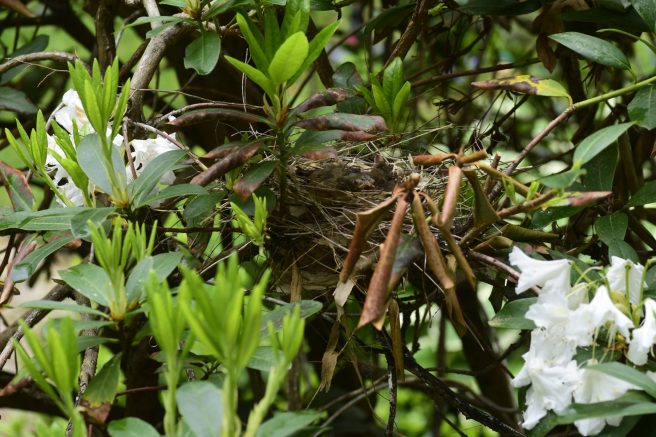
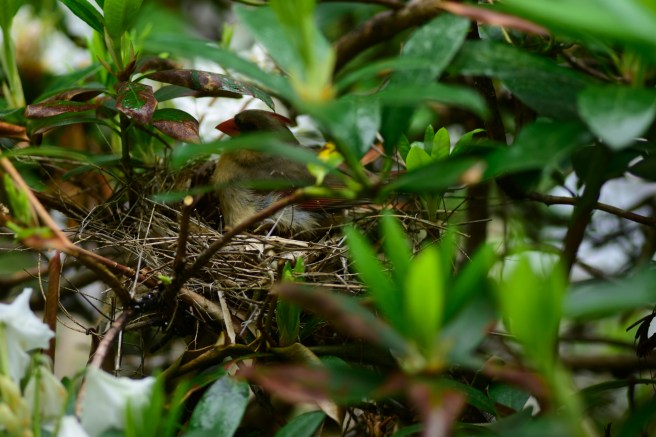
This Spring brought revelations from Nature. In early April the wings of two birds whizzed back and forth in fast motion in a Rhododendron, outside the kitchen window. Et voila!; A nest appeared. Within a few days a cardinal, lounging around in the concavity of straw and hay laid three small beige eggs, speckled with dark spots. They were visible from the upstairs window.
In previous seasons hatchlings were attacked and devoured by predators. But this year we were optimistic about the bird’s survival. The cardinal came daily to warm the eggs, which eventually hatched into three tiny breathing embryos. As the cardinal kept vigil over her tiny brood, the Redbird (male cardinal) came by to drop some nourishment into the cardinal’s beak. When the hatchlings developed into nestlings, the cardinal spent less time keeping them covered and provided them treats.
Several days passed when traces of wings emerged on the nestlings and black spots on their faces morphed into real eyes. Tiny talons were detectable. Day after day they got larger and larger and opened their beaks wider and wider, in apparent desperation to receive feedings from both the cardinal and the Redbird. Occasionally they flapped their wings.
When could they be called fledglings? I wondered. The answer came one morning when I looked down into the nest to see the sleeping birdies nestled in a perfectly circular shape, within the circumference of the nest. I thought I must take a picture. There was time! Wrong again! Looking out the kitchen window downstairs, the cardinal warmed her babies with the Redbird observing nearby. Suddenly I saw the cardinal stand on the edge of the nest and the Redbird drop bits of food into the very wide open mouths of his hungry brood. Unexpectedly, the Redbird and cardinal retreated. The nestlings flapped their wings, and one at a time they stretched their legs, stood on the edge of the nest and hopped down to the nearest branch. Once they were all out of the nest, but within the bush, in unison they flew away.
The cardinal and Redbird came back to the bush several minutes after the offspring fledged, seemingly in search of something they left behind. Later in the afternoon the Redbird foraged on the lawn, but the cardinal was no where to be found, and the fledglings were no where to be seen. A month later the cardinal and Redbird have come around the yard. It is hoped that since the babes flew the nest on April 17th that the parents have been giving them food and guidance in the forest. They say this can happen several days after the fledging.
Eleven days went by since the baby cardinals fledged. The nest had been vacant, until yesterday, when a pair of Robins brought mud and straw to the nest and vigorously ground and burrowed their bodies in the open space, as if preparing it for their own. I read that repurposing a nest is not a common practice, and that most birds prefer to build a new one. This must be the case because there has been no movement for a couple days now. I think it’s safe to say that the home of the baby cardinals is now an ‘Empty Nest.


Two young women take a selfie in front of the Fontana di Trevi.
A couple engaged in a conversation eating outdoor on the street.
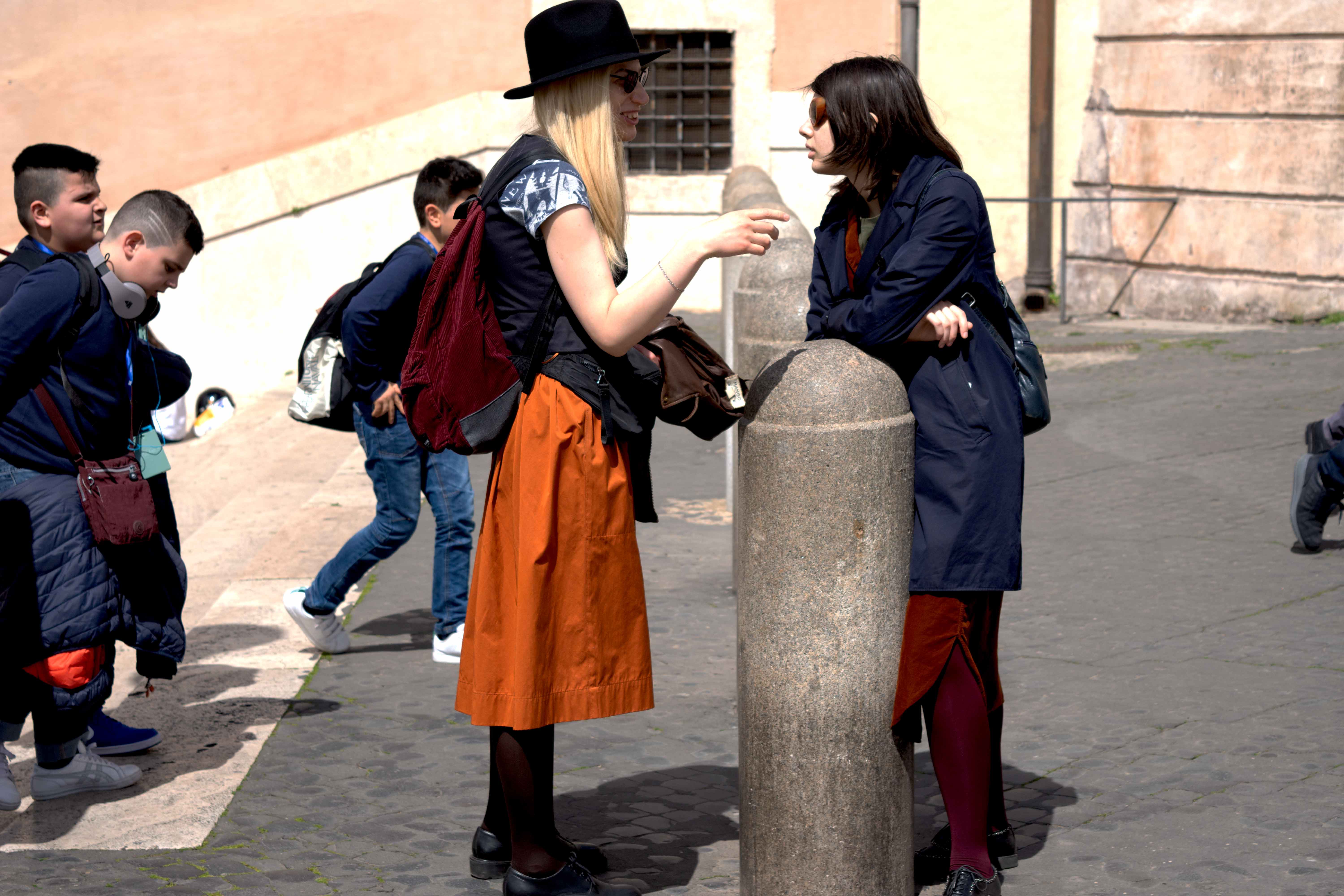
Two young women dressed with imagination, have a face to face sharing of words.
The time of year was April. The streets of Rome are always full of life.
Buon giorno!
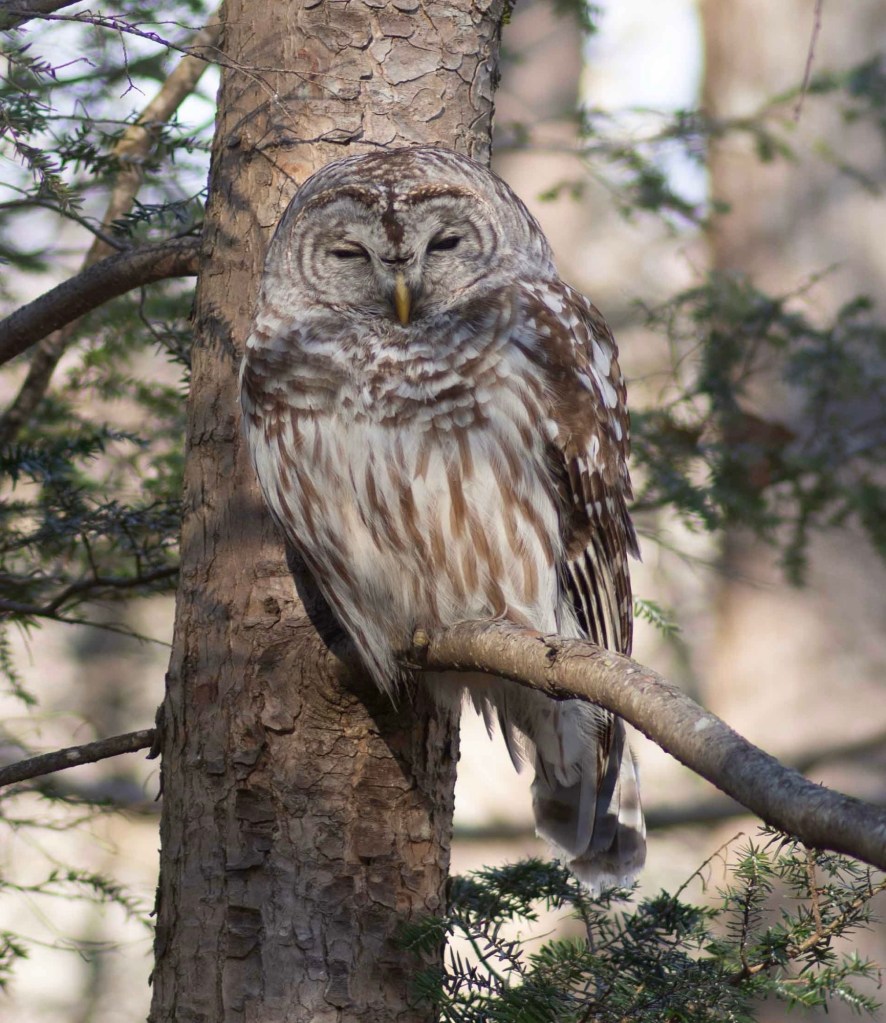
0ne early morning a sign of Spring appeared in the woods. It was a wise old owl who came to perch upon the limb of a tree not far from our house. He was rather quiet, except for a momentary eruption when he fanned his feathers, squawked and sent an intruding hawk on its way. Otherwise he slept throughout the day. Peace!
Please listen to the video from the next day. At the end of it you will hear the owl deep in the woods having his say.
It was one of those March days
When the sun shines bright
and the wind blows cold:
When it is summer in the light,
and winter in the shade.
Charles Dickens from “Great Expectations”
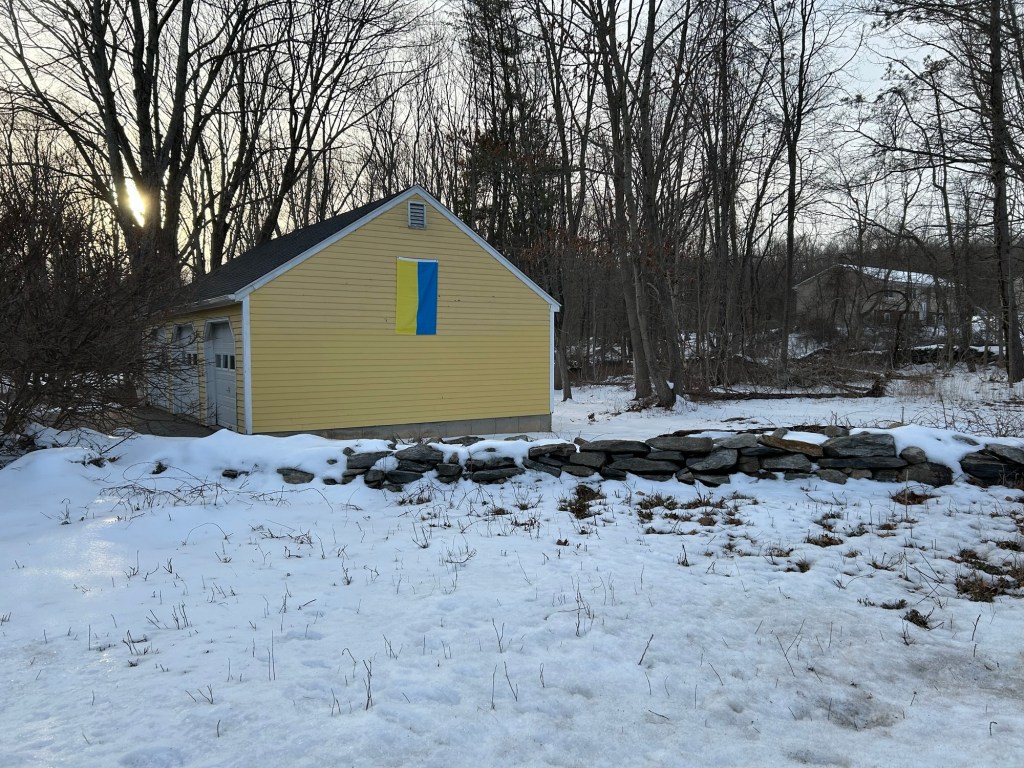
We fly your flag! Stay strong!
Connecticut, USA

 On Tiffany Creek