

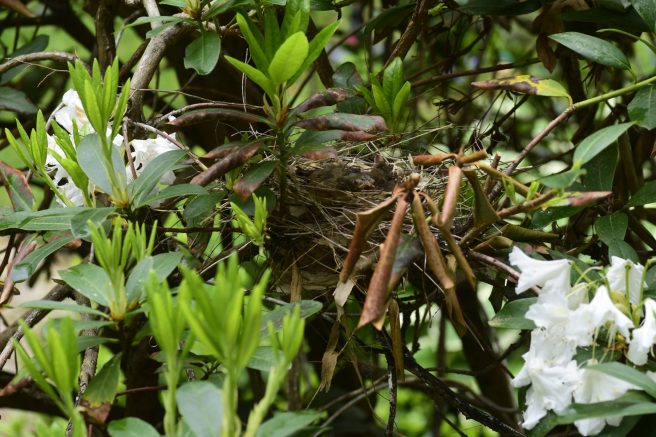
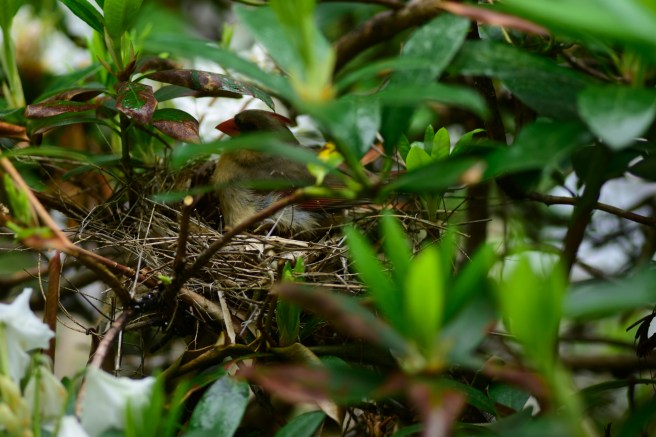
This Spring brought revelations from Nature. In early April the wings of two birds whizzed back and forth in fast motion in a Rhododendron, outside the kitchen window. Et voila!; A nest appeared. Within a few days a cardinal, lounging around in the concavity of straw and hay laid three small beige eggs, speckled with dark spots. They were visible from the upstairs window.
In previous seasons hatchlings were attacked and devoured by predators. But this year we were optimistic about the bird’s survival. The cardinal came daily to warm the eggs, which eventually hatched into three tiny breathing embryos. As the cardinal kept vigil over her tiny brood, the Redbird (male cardinal) came by to drop some nourishment into the cardinal’s beak. When the hatchlings developed into nestlings, the cardinal spent less time keeping them covered and provided them treats.
Several days passed when traces of wings emerged on the nestlings and black spots on their faces morphed into real eyes. Tiny talons were detectable. Day after day they got larger and larger and opened their beaks wider and wider, in apparent desperation to receive feedings from both the cardinal and the Redbird. Occasionally they flapped their wings.
When could they be called fledglings? I wondered. The answer came one morning when I looked down into the nest to see the sleeping birdies nestled in a perfectly circular shape, within the circumference of the nest. I thought I must take a picture. There was time! Wrong again! Looking out the kitchen window downstairs, the cardinal warmed her babies with the Redbird observing nearby. Suddenly I saw the cardinal stand on the edge of the nest and the Redbird drop bits of food into the very wide open mouths of his hungry brood. Unexpectedly, the Redbird and cardinal retreated. The nestlings flapped their wings, and one at a time they stretched their legs, stood on the edge of the nest and hopped down to the nearest branch. Once they were all out of the nest, but within the bush, in unison they flew away.
The cardinal and Redbird came back to the bush several minutes after the offspring fledged, seemingly in search of something they left behind. Later in the afternoon the Redbird foraged on the lawn, but the cardinal was no where to be found, and the fledglings were no where to be seen. A month later the cardinal and Redbird have come around the yard. It is hoped that since the babes flew the nest on April 17th that the parents have been giving them food and guidance in the forest. They say this can happen several days after the fledging.
Eleven days went by since the baby cardinals fledged. The nest had been vacant, until yesterday, when a pair of Robins brought mud and straw to the nest and vigorously ground and burrowed their bodies in the open space, as if preparing it for their own. I read that repurposing a nest is not a common practice, and that most birds prefer to build a new one. This must be the case because there has been no movement for a couple days now. I think it’s safe to say that the home of the baby cardinals is now an ‘Empty Nest.


 On Tiffany Creek
What a gift for you…outside the kitchen window. This one sounds like a successful nesting too. Once they fledge, I assume they all make it, unless I have clear evidence to the contrary. I very much enjoyed your cardinal story.
LikeLike
Hello Etikser!
Yes, the greatest gifts are the ones we least expect to receive, and those we are willing to embrace wholeheartedly. I learned so much not only about science, but the giving and taking that goes on between a male and female cardinal. Most of all I relearned that Love is not defined by words or transactions, but is instinctual, conveyed by a super powerful force out there. If only humans could do better to emulate the cardinals. Since this post was published a Robin has re-purposed and re-occupied this nest and has laid two blue eggs, so far. Thank you!
LikeLiked by 1 person
How cool the robins repurposed the cardinal’s
LikeLike
How cool the robins have repurposed the nest. I didn’t know they’d do that. More good watching for you. I once saw a female cardinal feed a nearby fledgling robin that was sqwawking,as the do, “feed me”. It caused me to have very favorable feelings re Cardinals. They seem like nice birds, and I certainly appreciate their presence in the winter.
LikeLike